Homecoming Weekend ceremony celebrates leadership, legacy, and generations of service

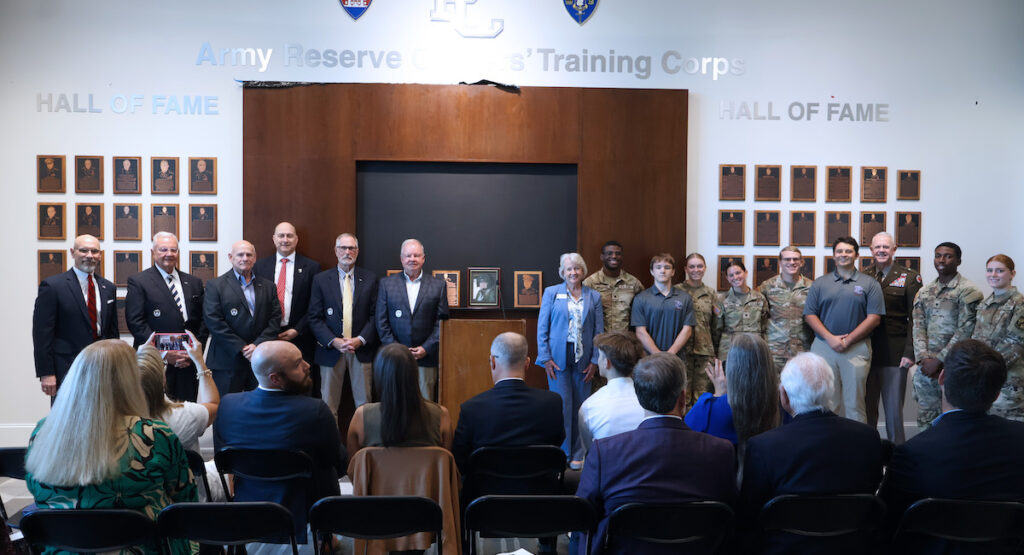
Presbyterian College celebrated a proud chapter in its military heritage Friday as it inducted Col. (Ret.) Grant C. Jaquith ’79 into the PC Army ROTC Alumni Hall of Fame and unveiled the Hall’s new home in the lobby of the Cornelson Center.
The dual ceremony, held during Homecoming Weekend, honored Jaquith’s decades of military and civilian service—from his 29 years in the U.S. Army Judge Advocate General’s Corps to his current post as a judge on the U.S. Court of Appeals for Veterans Claims—and reaffirmed PC’s century-long tradition of preparing leaders “of character, courage, and competence.”
Gustafson: A Tradition Rooted in Service
PC President Dr. Anita Gustafson opened the ceremony by tracing the college’s military ties to World War I and the founding of its ROTC unit in 1919.
“As a historian, I thought it would be appropriate to share the beginnings of this historic ROTC program,” she said, quoting from Ben Hay Hammett’s The Spirit of PC.
Gustafson recounted how the Students’ Army Training Corps briefly transformed campus life in 1918, preparing young men for wartime leadership. Within months, PC was selected to host one of the nation’s first Reserve Officer Training Corps units.
“Since that first class in 1919, PC’s ROTC program has grown into one of the most distinguished officer-commissioning programs in the nation,” she said. “By placing the ROTC Hall of Fame here in the Cornelson Center—at the very heart of our campus—we affirm that leadership development is central to Presbyterian College’s mission and identity.”

Gentry: Elevating a Legacy
Brig. Gen. (Ret.) John Gentry chair of the ROTC Alumni Council, called the relocation of the Hall of Fame a symbolic and overdue elevation of PC’s military legacy.
“When the ROTC program came to PC in January 1919, it began a tradition that has produced outstanding officers for more than a century,” Gentry said. “Today, we not only recognize Col. Jaquith’s achievements, but also the generations of Highlanders who answered the call to serve.”
He thanked alumni, faculty, and staff—including provost Dr. Erin McAdams and executive director of campus services Scott Respass—for making the new display possible. The renovated wall now features plaques of every inductee, a replica of Maj. Gen. George Mabry Jr.’s Medal of Honor, the Wysor Saber, and plans for a future tribute to Capt. Kimberly Hampton, the first female pilot killed in action.
“This display moves us from a basement mentality to a place of honor,” Gentry said. “It showcases 106 years of commissioning high-caliber officers—men and women who embody the best of what this college stands for.”
A Son’s Tribute
Introducing the day’s honoree, Gordon Jaquith, executive director for the Department of the Navy Relations and vice president and director of the Systems, Tactics, and Force Development Division at the Center for Naval Analyses, offered a personal and moving portrait of his father.
He began with a nod to family history.
“On that first day at Lexington and Concord, Benjamin Jaquith—my dad’s great-great-great-great-great-grandfather—stood with his neighbors to take on an empire,” he said. “Whether he fought for ideals or to protect his family doesn’t matter. He knew what was right and did it, no matter the cost. That’s the lesson my father has taught me all my life: It’s always the right time to do the right thing.”
Gordon Jaquith recounted his father’s path from a Presbyterian College ROTC scholarship student—a football letterman, fraternity president, and cadet corps commander—to a career Army lawyer who rose to colonel and chief of military law for U.S. Army Forces Command.
He described Jaquith’s reputation as “the rare combination of dynamic leader, extraordinary soldier, and brilliant lawyer.” As a military judge, he presided over dozens of high-profile courts-martial across the United States, Europe, and Korea; as a federal prosecutor and later U.S. Attorney, he pursued justice in complex homicide, corruption, and national-security cases.
“Dad’s list of achievements is remarkable not just for what he’s done, but how he’s done it—with integrity, humility, and grace,” his son said. “I’ve wanted to be just like him for as long as I can remember. It’s an honor to help induct him into the PC ROTC Hall of Fame.”
‘Gratitude Is the Greatest Virtue’
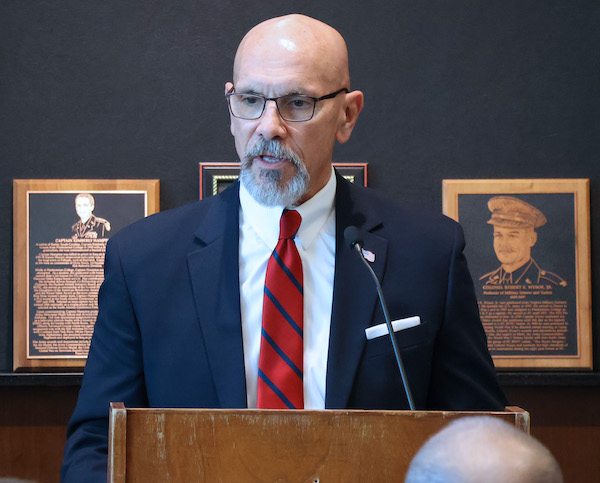
Taking the podium to sustained applause, Col. (Ret.) Grant C. Jaquith began his acceptance remarks with a quote from the Roman philosopher Cicero: “Gratitude is the greatest virtue and the parent of all other virtues.”
“It’s time for me to express gratitude for the many people who got me here,” he said, thanking the ROTC Alumni Council, his family, and his alma mater.
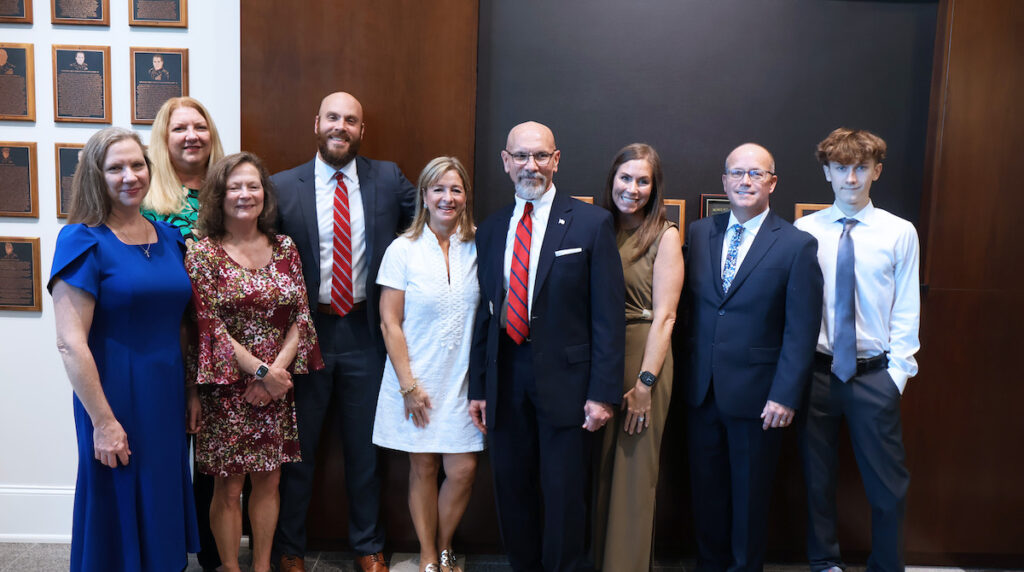
He paid special tribute to his wife, Rosemary Perez Jaquith, their six children, and nine grandchildren for their steadfast support.
“When I took the bench at Fort Bragg in 2006, my bailiff announced ‘All rise!’ But one daughter stayed seated and said, ‘Why should we? It’s just Dad.’ That keeps a judge humble,” he said.
Roots and Lessons
Jaquith reflected on the family and mentors who shaped him.
“My parents were nearly perfect,” he said. “They taught faith, frugality, service, and diligence—and to judge people by their character and conduct.” He also thanked his sisters and college friends “for being the brothers I didn’t otherwise have at a pivotal time in my life.”
Recalling his ROTC scholarship interview, Jaquith joked that his long hair nearly derailed his military aspirations. “They told me I’d have to cut it,” he said. “I told them I’d cut it as short as my ears for wrestling season. They picked me anyway—and they clearly got the last laugh.”
He said his half-century association with the Army and the law has been guided by a single maxim: “Do the right thing in the right way for the right reason under the law.”
“That’s easy to say and hard to do,” he continued. “The path of the law is not always smooth or clearly marked. The key is humility—to listen, to be attentive to detail, and to learn.”
Whatever your career path, commitment to service and leadership excellence are ingredients for greatness. The principles you learn here will serve you well—in uniform, in the courtroom, in corporate life, and at home.”
Col. (Ret.) Grant C. Jaquith to Highlander Battalion cadets
Service and Leadership
Jaquith credited his ROTC training and PC education for preparing him to live out the college’s motto, “While We Live, We Serve.” He said that ideal aligns perfectly with the Army values of loyalty, duty, respect, selfless service, honor, integrity, and personal courage.
“Those values form a recipe for success—including any I’ve been blessed with,” he said. “I’m fortunate now to serve on the U.S. Court of Appeals for Veterans Claims, blending 32 years of Army service and 31 years with the Department of Justice. But I could not be on the court today if I had not learned service and leadership lessons here.”
He also credited fellow Hall of Famers and former teammates for teaching perseverance:
“Doing the right thing in the right way can be hard work—sometimes painful—as Generals Rick Porter and Jack Ziegler reminded me on the football field.”
A Challenge to Cadets
Addressing current members of the Highlander Battalion, Jaquith urged them to “go all in” on ROTC opportunities.
“Whatever your career path, commitment to service and leadership excellence are ingredients for greatness,” he said. “The principles you learn here will serve you well—in uniform, in the courtroom, in corporate life, and at home.”
He spoke about servant leadership, calling it “the hallmark of success in any organization.”
“Workers who trust that their leaders value their welfare propel their teams to success,” he said. “That’s true in the military, in the courts, and even at home—where the selfless leadership of our parents, spouses, and friends launches our achievements.”
Jaquith closed with characteristic humility.
“I’m grateful to be honored alongside PC’s finest,” he said. “And I’m grateful to those present in person or in spirit who did the really hard work to show me the way—to endure my errors and to encourage, coach, teach, push, and pull me along to make it. Thank you all.”
Presbyterian College’s Living Legacy
As applause filled the Cornelson Center lobby, the new ROTC Hall of Fame Wall of Distinction gleamed—a visual reminder of PC’s 106-year legacy of leadership and service.
For President Gustafson, that connection between past and present defines the college’s mission.
“By placing the Hall of Fame here at the heart of campus, we ensure that the extraordinary legacy of service flowing from this institution will stand as an inspiration to current cadets and future generations,” she said.
About Col. (Ret.) Grant C. Jaquith ’79
A 1979 Presbyterian College graduate, Grant C. Jaquith served in the U.S. Army Judge Advocate General’s Corps from 1982 to 2011, retiring as a colonel after assignments as circuit judge and chief of military law for U.S. Army Forces Command. He spent three decades as a federal prosecutor and U.S. Attorney in the Northern District of New York before his 2020 appointment to the U.S. Court of Appeals for Veterans Claims.
He and his wife, Rosemary, have six children and nine grandchildren.