
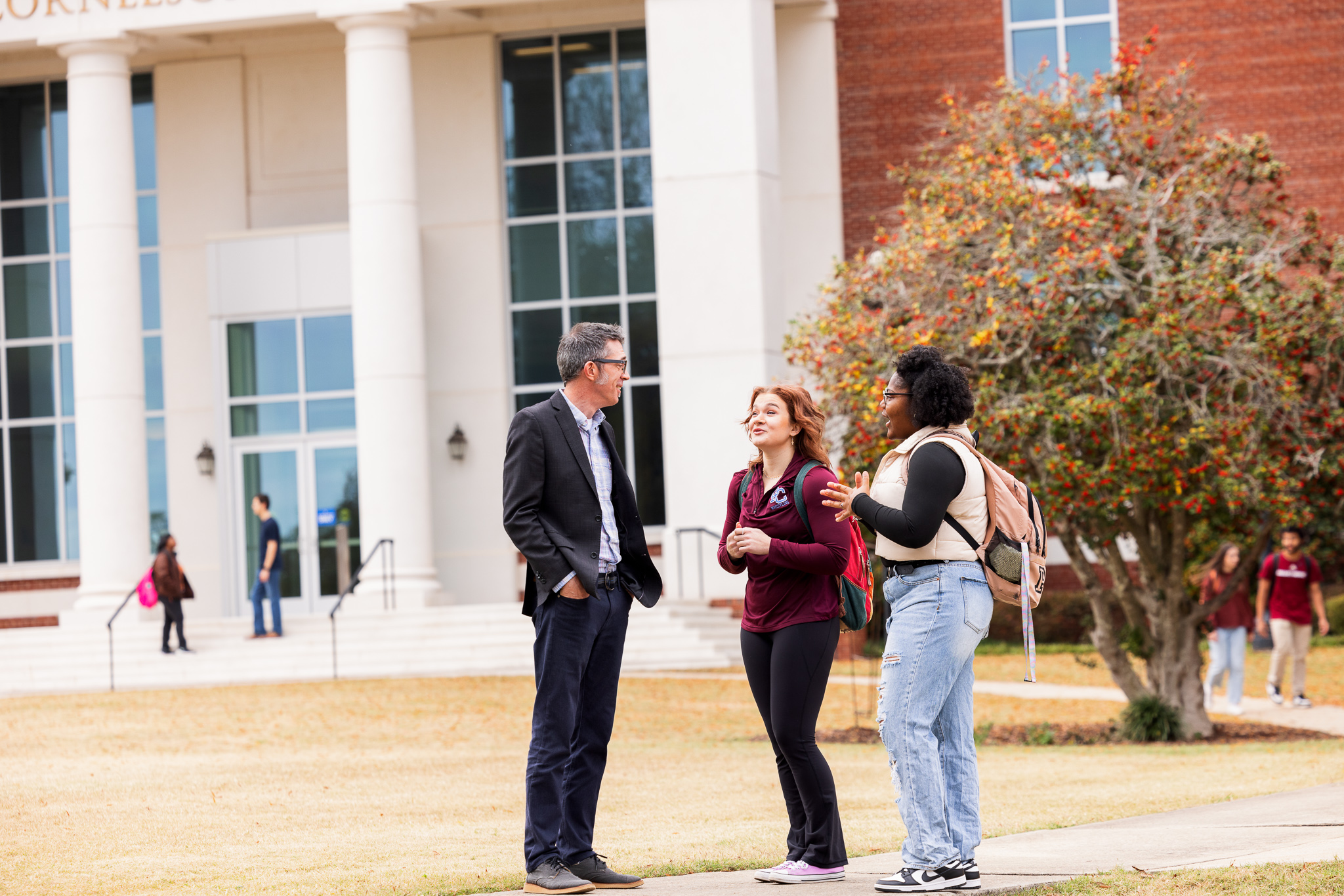

Let grants open the door to a great college experience
Grants are a powerful way to reduce the cost of college — and they don’t have to be repaid. At Presbyterian College, we believe every student should have access to a transformative education. That’s why we connect you with need-based grants that make it easier to pursue your purpose.

Questions about Financial Aid?
Check out short, helpful videos that explain everything from scholarships to FAFSA at Presbyterian College’s Financial Aid TV. It’s a quick, easy way to get the info you need—anytime.
$7,395
The maximum Pell Grant amount in 2025–26
42%
of PC students receive a PC Grant
80%
of our S.C. students receive a
South Carolina Tuition Grant
Federal Grants
Pell Grant
A Federal Pell Grant is free money for college that doesn’t have to be repaid. It’s awarded to undergraduate students who demonstrate significant financial need and haven’t earned a bachelor’s or graduate degree. This grant helps make college more affordable by covering tuition, fees, and other educational expenses.
To be considered for a Pell Grant, you should start by submitting the Free Application for Federal Student Aid (FAFSA) form. PC and other schools use the information on the FAFSA to determine your eligibility and how much you can receive. You’ll need to fill out the FAFSA each year you’re in school to stay eligible for federal student aid, including Pell Grants. Include the Presbyterian College code when you file the FAFSA. The code is 003445.
Federal Supplemental Educational Opportunity Grant
A Federal Supplemental Educational Opportunity Grant (FSEOG) is additional free money for college that doesn’t have to be repaid. It’s awarded to undergraduate students who demonstrate exceptional financial need and are also eligible for the Federal Pell Grant. This supplemental grant provides extra financial assistance to help cover educational expenses.
To be considered for an FSEOG, you must complete the Free Application for Federal Student Aid (FAFSA). Students must be eligible for Pell Grant to receive SEOG funds that range from $100 – $4,000. Funding is limited and varies each year. This grant does not automatically renew from year to year, so you’ll need to submit a new FAFSA annually to be considered.
South Carolina Tuition Grant
A South Carolina Tuition Grant is free money for college that doesn’t have to be repaid. It’s awarded to South Carolina residents who demonstrate financial need and attend approved private colleges and universities within the state. This grant helps make college more affordable by providing up to $5,000 per year toward tuition costs. To be considered for a South Carolina Tuition Grant, you should start by submitting the Free Application for Federal Student Aid (FAFSA) form.
The state uses the information on your FAFSA to determine your eligibility and how much you can receive. You’ll need to be enrolled as a full-time student and maintain satisfactory academic progress. File your FAFSA as early as possible after December 1st, with a state priority deadline of August 1. You’ll need to fill out the FAFSA each year you’re in school to stay eligible for state aid, including the South Carolina Tuition Grant.
PC Grant
The PC Grant is free money for college that doesn’t have to be repaid. It’s awarded to students who demonstrate financial need based on their FAFSA submission. This grant helps make PC more affordable, with 42% of our students receiving this valuable financial assistance. For the 2023-2024 academic year, families receiving the PC Grant reported an average Adjusted Gross Income (AGI) of $82,955 on their federal taxes, showing that middle-income families often qualify.
To be considered for a PC Grant, simply submit your Free Application for Federal Student Aid (FAFSA). PC uses the information on your FAFSA to determine your eligibility and award amount. Remember to submit your FAFSA each year to maintain your eligibility for all forms of financial aid, including the PC Grant. Learn more about the PC Grant and how it can help make your education more affordable.
TEACH Grant
A TEACH Grant is federal money for college that can potentially convert to a loan if service requirements aren’t met. It’s awarded to students who commit to teaching in high-need fields in schools serving low-income families after graduation. This grant provides up to $4,000 per year to help make your education more affordable.
To be considered for a TEACH Grant, you need a 3.25+ GPA or 75th percentile test scores, plus admission to PC’s Education Department. You must complete an Agreement to Serve and TEACH Grant Counseling annually at studentaid.gov. Important: If you don’t fulfill four years of qualifying teaching service within eight years after graduation, your grants convert to Direct Unsubsidized Loans with retroactive interest.
Course Program of Study (CPOS)
To be eligible for Federal Financial Aid, a course must count toward the student’s Course Program of Study (CPOS)—the set of courses required to complete the declared degree requirements for graduation. Federal financial aid regulations emphasize that federal grants, work-study, and loans may be reduced if a student enrolls in coursework that is not eligible for financial aid purposes. Students should ensure they are taking only courses that apply to their degree plan, because enrolling in ineligible classes can affect full-time status and therefore financial aid amounts.
Overall, this rule is meant to ensure students are enrolled in the correct courses needed to graduate. It is supported by federal requirements that institutions use financial aid funds only for courses applicable to a student’s degree program.
Federal Financial Aid Includes:
- Federal Pell Grant
- Federal Supplemental Educational Opportunity Grant (SEOG)
- Federal Subsidized Loan
- Federal Unsubsidized Loan
- Federal PLUS Loan
- Federal Graduate PLUS Loan
The basic requirements for a bachelor’s degree from Presbyterian College are:
- Successful completion of the required general education courses
- Completion of the requirements for an academic major
- Successful completion of 122 semester hours of college-level work with a minimum of 48 hours successfully completed at Presbyterian College (NOTE: credit-hour requirements in some majors may increase required hours to more than 122 for these areas of study)
- Completion of all academic work with 2.00 cumulative grade point average (GPA)
- Completion of all courses used to complete the general education requirements with a 2.00 cumulative GPA
- Completion of all major requirements (and minor requirements if applicable) with a 2.00 cumulative GPA
General Education
A normal range for general education requirements PC is 47–53 credit hours. For Federal financial aid purposes, General education courses must satisfy the requirement for the degree.
Electives
Electives must satisfy a requirement of the student’s declared major to be eligible for Federal financial aid. Required electives are courses not necessarily related to the major but are necessary to reach the minimum credits required by the degree.
Dual Degrees and Double Majors
Courses taken for a dual degree or second major are degree pursuant. Requirements for either may be combined each semester; however, once a student has completed the requirements for the first degree, they are considered to have earned a degree and no longer eligible for Federal Pell Grant nor Federal SEOG. Thus, to continue to receive Federal grant(s), students must complete the last requirements for both degrees/majors in the same semester. However, that student may still receive Federal Work-Study and Direct Loan funds to complete the requirements of the second degree/major program.
Minors
Federal financial aid cannot be disbursed for courses toward a minor, unless the minor is required for the degree. Presbyterian College currently has one major: B.A. in History that requires the student to minor before they can graduate. Minor courses can be taken as required electives in programs to fulfill the 122 hours toward graduation requirements.
At Presbyterian College, it’s essential that your major is officially declared and recorded in your student records. If you plan to change or declare your major, you should contact your academic advisor and submit the required Major Change Form. You should not enroll in courses toward the new major until the update is reflected in the college systems (e.g., Banner/DegreeWorks). Financial aid course eligibility is based on the officially declared major on your record, and changes generally can’t be made retroactively.
While PC requires students to declare their major with the Registrar no later than the end of the first semester of the junior year, students receiving Federal Financial Aid must declare their major once they have earned 60 hours.
Financial aid is initially awarded based on the assumption that undergraduate students will enroll full-time during the fall and spring semesters. Students may only receive federal financial aid for outstanding coursework that counts towards their officially declared program of study. State, institutional and private aid requirements may vary when it comes to CPOS requirements as shown below.
| Undergraduate Enrollment Intensity | Eligible for Federal Grants (Pell Grant and FSEOG) | Eligible for Federal Loans (Subsidized & Unsubsidized) | Eligible for State Aid | Eligible for Institutional Aid | |
|---|---|---|---|---|---|
| Full Time | 12+ credits per semester | Yes, maximum eligibility | Yes, maximum eligibility | Yes, maximum eligibility | Yes, maximum eligibility |
| Three Quarter Time | 9-11 credits per semester | Yes, prorated to enrollment intensity | Yes, prorated | Not eligible | Not eligible |
| Half Time | 6-8 credits per semester | Yes, prorated to enrollment intensity | Yes, prorated | Not eligible | Not eligible |
| Less than Half Time | 1-5 credits per semester | Yes, prorated to enrollment intensity | Not eligible | Not eligible | Not eligible |