Alumnus and real estate executive shares industry insights and life lessons
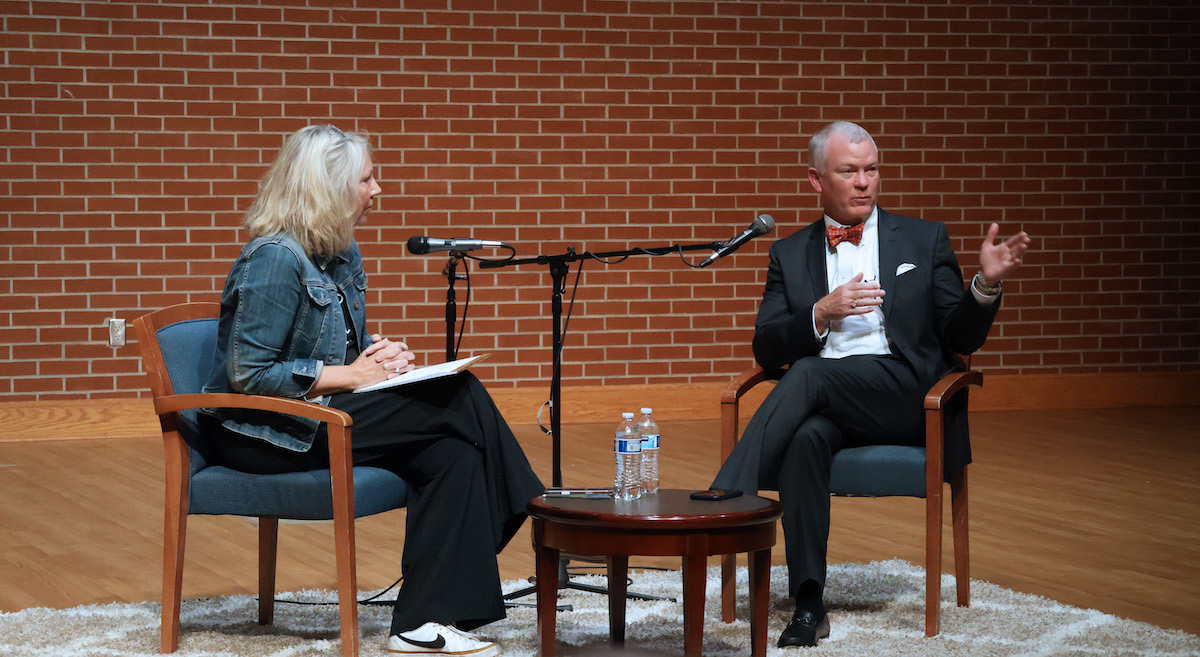
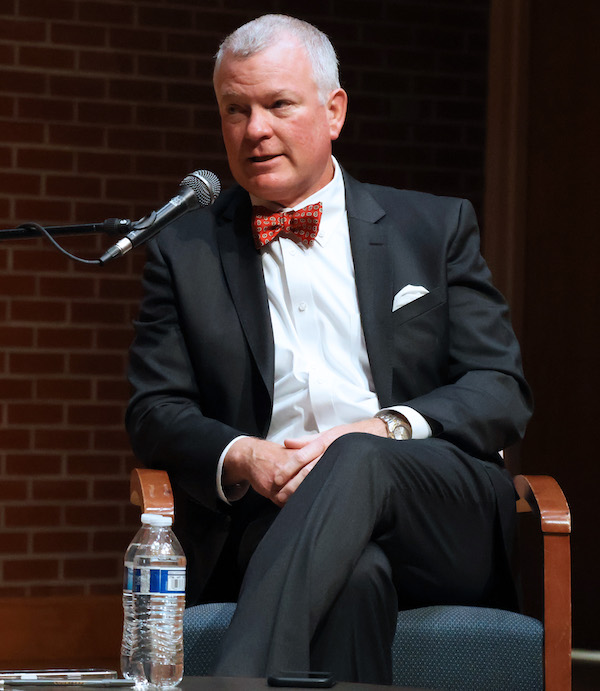
Presbyterian College alumnus Lee Hunter ’94, chief operating officer of Hunter Hotel Advisors, returned to campus Wednesday night to share lessons learned from a lifetime in business, family, and service during the 2025 Truist Lecture on Free Enterprise in Edmunds Hall.
In an interview-style forum moderated by local real estate professional and newly-named Honorary Alumna Susan Tallman, the onstage conversation offered students a candid glimpse into the fast-paced world of hotel real estate—and into the enduring values that Hunter said continue to shape his career and life.
A Family Business Built on Finding the Niche
Hunter told the audience that his career path began with the example of his father, who founded Hunter Hotel Advisors in 1978 after leaving IBM to pursue commercial real estate. When a few early assignments led him to broker hotel properties, he realized he had stumbled into an overlooked market segment.
“He realized it was a niche business that nobody else was doing,” Hunter said. “So, he put up a shingle and said, ‘Hi, we’re running a hotel business.’ He’s been selling hotels ever since.”
That entrepreneurial leap set the course for what would become one of the nation’s leading advisory firms specializing in hotel sales. Hunter joined the company after earning his degree from Presbyterian College and a master’s from Cornell University, eventually becoming its chief operating officer alongside his brother, Teague ’95, also a PC graduate.
Today, the Atlanta-based company handles transactions across the United States for private investors, real estate investment trusts, and major equity groups.
“What I do is play Monopoly for a living,” Hunter told students with a smile. “I buy and sell hotels—but for real money.”
From PC to the Ivy League
Hunter said the business program at Presbyterian College gave him the academic foundation and accountability he needed to thrive at Cornell and in his profession.
“PC absolutely prepared me for Cornell,” he said. “The hard part about the Ivy League is getting in. One plus one equals two wherever you go. Once you’re there, it’s the same thing.”
He credited Dr. Fred Chapman, one of his professors in the 1990s, with instilling a culture of discipline that mirrored real-world expectations.
“If you showed up in Dr. Chapman’s class unprepared, it was hell,” Hunter recalled. “He held us accountable—and that accountability translated directly into the workplace.”
That same ethic, he said, has shaped the way he manages his team of brokers across the country.
“When you graduate, you’re in the world of eight o’clock classes and zero cuts,” he said. “So, get used to it now.”
Psychology, Patience, and Purpose
Though Hunter double-majored in business and accounting, he told students that psychology has proven just as important to his success.
“I’ve seen deals with a lot of zeros behind them happen for non-financial reasons,” he said. “The psychology of it all—the human nature of it—often trumps the numbers.”
Understanding motivation, Hunter explained, is key to making any deal work.
“You have to know what’s driving someone,” he said. “What’s their motivation? How can you leverage that motivation to make sure the deal gets closed?”
He advised students to develop emotional intelligence along with financial literacy.
“Everybody’s in sales,” he said. “Doctors, lawyers, accountants—we’re all selling ourselves every day.”
One of his biggest career lessons, he added, came from a moment of impatience early in his career.
“I once left a company because I was offered a bigger paycheck,” he admitted. “That was the wrong reason. Go for the experience, not the money. Learn everything you can where you are. The paycheck will come later.”
Any idiot can make a dollar. It takes a smart man to save one. And it takes a good person to share it.”
Lee Hunter ’94
Lessons in Resilience
Hunter shared personal stories that reflected both resilience and humility. After working several years on the buy side of hotel investment, he was recruited to another firm to manage a new debt fund. But while he was on his honeymoon, the company unexpectedly closed the fund.
“I got back to the office, and they told me, ‘We shut down the fund while you were gone,’” he recalled. “So, I called my wife—and then I called my brother. He said, ‘Have you talked to Dad?’ I said no. He said, ‘Well, you know what he’s going to tell you.’ And that’s how I ended in the family business.”
The experience, Hunter said, reinforced the need to plan intentionally but remain adaptable.
“At the end of the day, all we have is time,” he told the audience. “Use it wisely. Be intentional about your goals and how you spend each day pursuing them.”
Market Shifts and the Human Factor
Drawing on his experience overseeing billions in hotel transactions, Hunter explained how market psychology and global events can ripple through the industry.
In 2022, Hunter Hotel Advisors closed 174 single-asset transactions totaling about $2.5 billion. By 2023, rising interest rates and economic uncertainty cut that number in half.
“We did half the business with the same number of employees,” he said. “Interest rates went up, cap rates went up, values went down—and sellers didn’t want to sell. It usually doesn’t work well when your revenue drops but your expenses stay the same.”
Despite the challenges, Hunter said the company’s emphasis on relationships and service keeps it competitive against larger national firms.
“We’re punching way above our weight,” he said. “We compete against giants like CBRE and (Jones Lang LaSalle), but our clients stick with us because of the service. People do business with people they like, trust, and respect.”
That commitment to integrity, he added, traces back to his undergraduate years at PC.
Service as a Way of Life
Reflecting on Presbyterian College’s motto, “While We Live, We Serve,” Hunter said service remains at the heart of his company’s mission. Each year, he helps organize a major hotel investment conference in Atlanta that brings together students, executives, and investors from across the nation.
The event—now drawing more than 2,000 attendees—supports scholarships at Georgia State University’s School of Hospitality and offers networking opportunities for students from over 30 colleges and universities, including South Carolina, Auburn, Cornell, Michigan State, Penn State, and Houston.
“We wanted to create a space for learning and connection,” Hunter said. “Every major hotel brand sponsors it, and we use it to give back through scholarships and mentoring.”
The COVID-19 pandemic, he added, sparked a new form of outreach. When the conference was postponed in 2020, Hunter and his brother launched “Teague Talks” and “Teague Walks”—a YouTube series featuring interviews with hospitality leaders and behind-the-scenes tours of properties.
“We started recording Zoom interviews with hotel CEOs,” he said. “Now Marriott has asked us to film a Teague Walk on one of their new Ritz-Carlton cruise ships.”
Balancing Work and Family
For all his professional success, Hunter said his proudest achievements are personal. He and his wife have two children, and he has made a deliberate effort to be part of their daily lives—even when it means sacrificing deals.
“I coached my kids from second grade through middle school in football, basketball, and baseball,” he said. “Have I lost business because of that? Absolutely. But that’s a decision I’d make again every time.”
He laughed that his office sometimes complains he doesn’t travel enough, while his wife thinks he travels too much.
“If both sides are mad, I’m probably doing the right thing,” he said.
Words for the Next Generation
Hunter closed by urging students to pursue their careers with discipline, curiosity, and service.
“Be the person who shows up,” he said. “Be the one people can count on. Because in business and in life, consistency and integrity will take you farther than anything else.”
He also reminded them that success is not only measured by income or title but by the way one uses their gifts.
“Any idiot can make a dollar,” he said, quoting his grandfather. “It takes a smart man to save one. And it takes a good person to share it.”