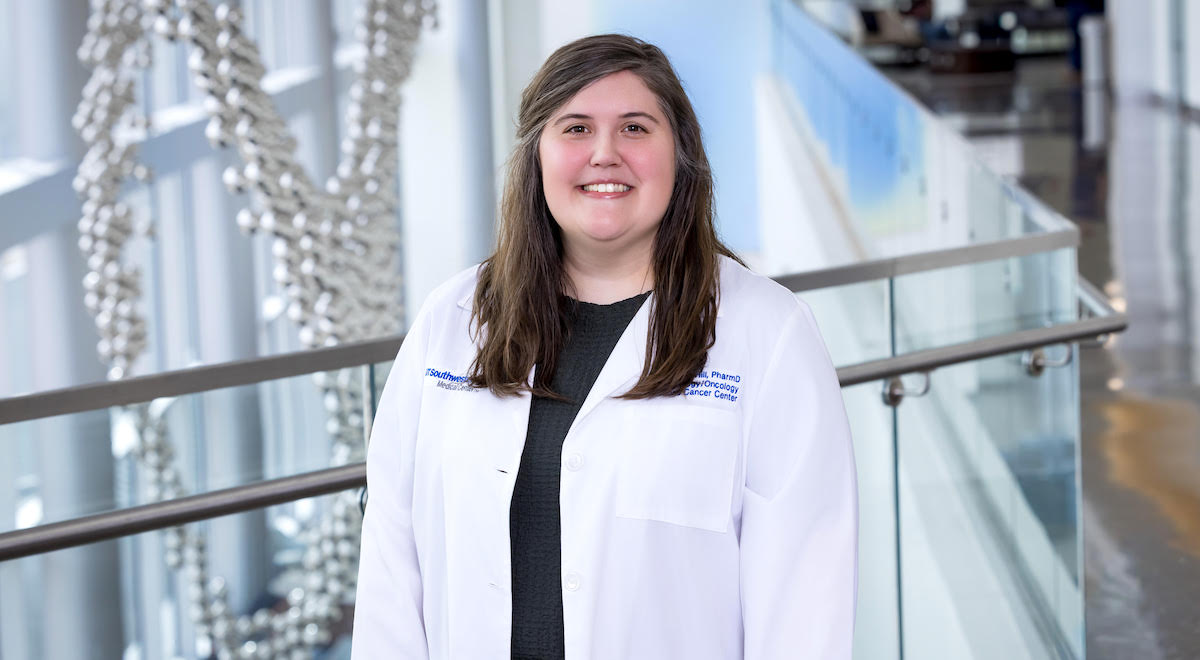
Dr. Katherine Hill discovered her passion for clinical oncology pharmacy by coincidence.
Going into her first year at the Presbyterian College School of Pharmacy, Hill always knew that she wanted to work in a hospital setting. But it was during her fourth year when her mom was diagnosed with breast cancer that her path became clear, and was further solidified by her field experience.
“One day, I ended up shadowing an oncology pharmacist on rotation,” she said. “I’d already enjoyed learning about it in the classroom, and then during my residency, I decided that’s what I wanted to do.”
Originally from Louisiana, Hill’s father, the Rev. Joseph Hill, a 1972 PC graduate, encouraged her to look into the pharmacy program.
“I looked into it, and immediately everybody was so welcoming, so happy to see you, and it just felt good to be on campus,” she said. “I came back, and I was like, ‘Dad, I don’t know what it is, but I think I’m going to go there.’”
Following her father’s footsteps, Hill graduated in 2021, 49 years after her dad.
There are a lot of opportunities that PC offers to be involved with organizations, or even at the state level that you probably wouldn’t find elsewhere,” she said. “Those experiences develop you as a leader and as a professional, so I owe a lot of my successes to that.”
Dr. Katherine Hill ’21, Oncology Pharmacist, UT Southwestern Medical Center
Since graduating from PC’s School of Pharmacy, Hill has made a name for herself, currently serving as the lead outpatient oncology clinical pharmacy specialist at UT Southwestern Medical Center in Dallas, Texas, a position she’s held for just under a year.
“It’s been fun to have different insight, not only when practicing, but through training my coworkers and being a resource and an aid for them as well,” she said.
Hill attributes her success in her career to her time as a graduate student at PC, expressing her gratitude for the school that made her feel at home while miles away from her own, and the program that went above and beyond to prepare her for the future.
“If at any point I can give thanks to PC, I always do,” she said. “I really think that I wouldn’t be here doing what I’m doing if it wasn’t for PC.”
She credits the small class sizes, the close relationships she was able to build with her professors, and the endless opportunities for helping her transform into the leader she is today.
“There are a lot of opportunities that PC offers to be involved with organizations, or even at the state level that you probably wouldn’t find elsewhere,” she said. “Those experiences develop you as a leader and as a professional, so I owe a lot of my successes to that.”
While her education was undoubtedly essential to her success, Hill also encourages students to take some of the pressure off themselves academically, because what happens outside of the classroom is just as important.
“Take those opportunities to get to know people, to network, to step out of yourself and your comfort zone,” she encouraged. “The academics are important, but they’re not everything.”