Senior psychology major blends athletics, mental health advocacy, and postgraduate ambition
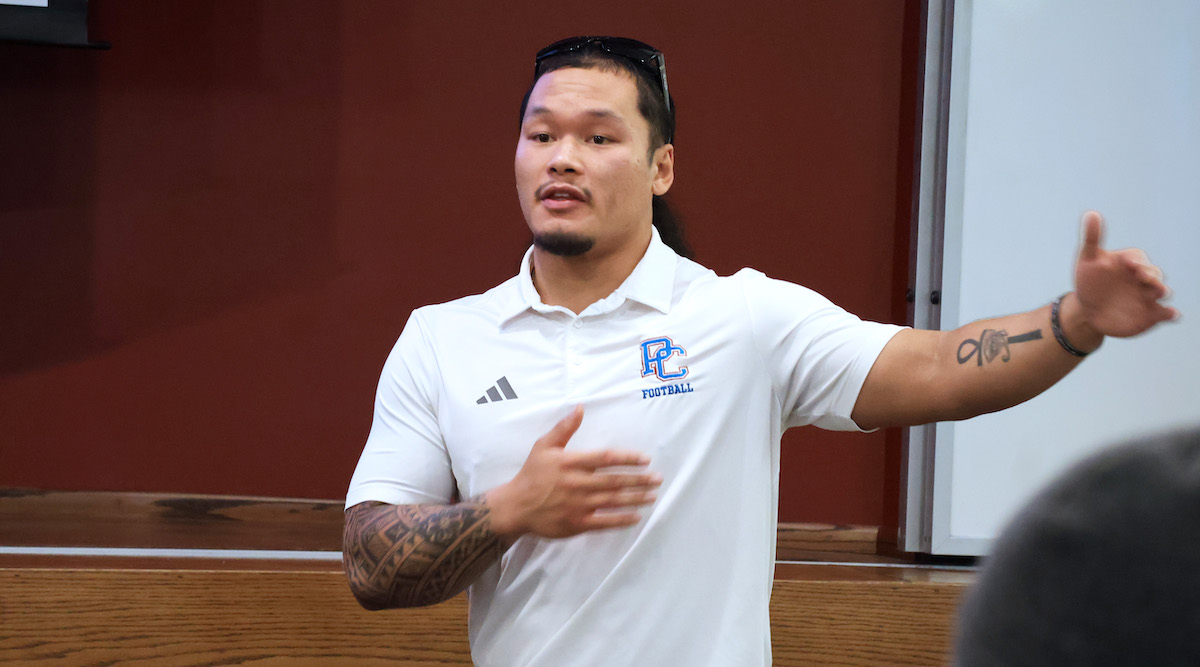
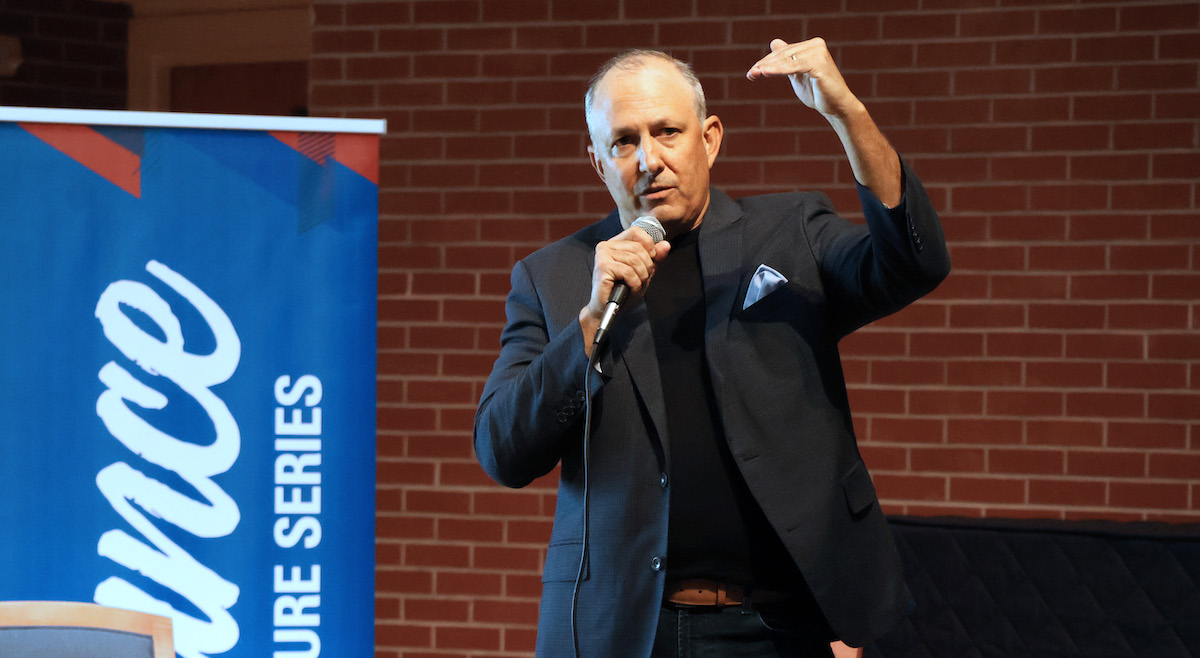
By the time Jason Briones stood before an audience in the Harrington-Peachtree amphitheater to present his senior capstone research, he was already preparing for two transitions at once.
One would take him to the end of his college career as a student-athlete in December. The other could take him back home to Canada, where he plans to declare for the Canadian Football League draft this spring in hopes of extending his football playing career.
For Briones, the moments were not separate achievements but parallel reflections of a journey shaped by discipline, community and purpose.
“I love PC,” Briones said. “It was a great experience not just athletically, but academically. PC gave me an opportunity to grow as a man.”
Research rooted in community
Briones’ senior capstone focused on peer support among college students and its implications for Presbyterian College, a topic he approached with both scholarly rigor and personal conviction. Opening his presentation with a quote attributed to Archbishop Desmond Tutu—“My humanity is bound up in yours, for we can only be human together”—Briones framed mental health not as an individual crisis but as a shared responsibility within a community.
His research examined how peer support can complement professional counseling, particularly in college environments where students face mounting academic, social and personal pressures.
“College mental health is important, and community is very important within college,” Briones said.
Drawing on existing literature, he highlighted research showing that untreated mental health concerns are associated with lower graduation rates and reduced academic persistence, while positive mental health correlates with stronger academic outcomes. Rather than treating mental health solely as a response to crisis, Briones emphasized the importance of proactive support and early education in coping strategies.
Listening before prescribing
To understand how peer support might function effectively at Presbyterian College, Briones conducted qualitative research using student focus groups. Sixteen students representing different class years, genders, racial backgrounds, majors and campus affiliations—including student-athletes and members of Greek life—participated in recorded discussions. Briones analyzed the transcripts using systematic qualitative coding to identify recurring themes.
What emerged was a nuanced portrait of student life: competing demands between academics, athletics and work; persistent stigma around mental health, particularly among men and student-athletes; uneven awareness of available resources; and a strong desire for mentorship grounded in shared experience.
“What works there is not going to work here,” Briones told his audience, explaining why campus-specific voices mattered more than importing generic solutions. Students expressed interest in peer support that felt authentic rather than clinical, flexible rather than rigidly scheduled, and grounded in trust rather than authority. Many emphasized that peer support should enhance—not replace—professional counseling.
From data to lived experience
Instead of presenting his findings as a list of abstract themes, Briones translated the research into two fictional composite narratives: Talia Dubose, a student-athlete navigating academic and athletic pressures, and Rome Afalu, a first-generation student balancing a demanding science major with off-campus work.
Through their stories, Briones illustrated how peer support could function across different stages of a student’s college career—from first-year stress and stigma to mentorship, referral and long-term growth. The narratives reflected real concerns raised in the focus groups, including fears of appearing weak, challenges finding time for counseling, and the importance of being able to talk openly with someone who understands the realities of college life.
In both cases, peer support served as a bridge—sometimes offering relief on its own, other times guiding students toward professional help when needed.
“Peer support will never replace counseling, but it can support it and complement it,” he said.
“I love PC. It was a great experience not just athletically, but academically. PC gave me an opportunity to grow as a man.”
Jason Briones ’25
A student-athlete’s perspective
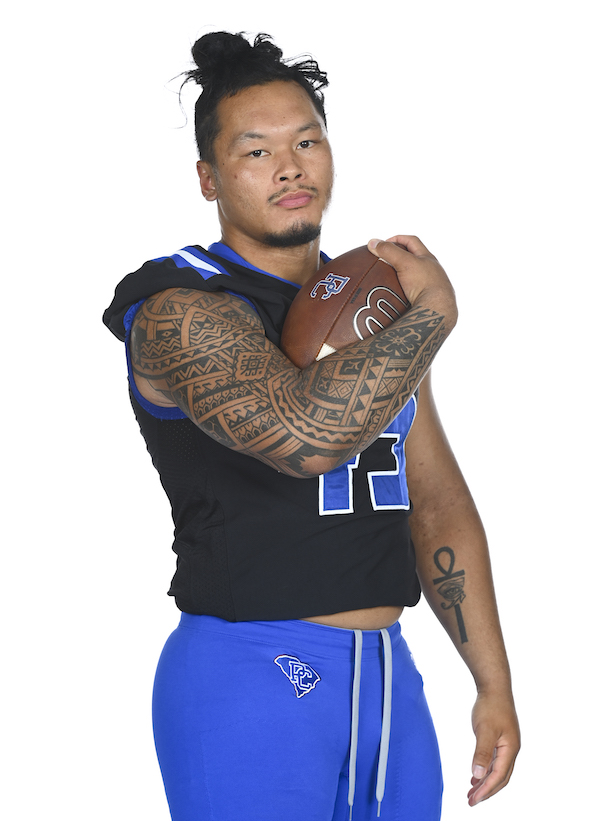
Briones’ insights were shaped in part by his own experience as a student-athlete. A member of Presbyterian College’s 10-2 football team, he understood firsthand the pressure to perform both on the field and in the classroom.
That dual identity surfaced repeatedly in his research, particularly in discussions of stigma and conflicting demands. Student-athletes in the focus groups described strong team bonds but also hesitation to open up emotionally in competitive environments.
Briones’ work highlighted the need for support systems that acknowledge those realities without reinforcing stereotypes about strength and vulnerability. His capstone presentation, delivered during his final semester, served as both an academic culmination and a reflection on the culture he helped shape during his time at PC.
From Toronto to Clinton
Briones’ path to Presbyterian College was not a short one. Originally from Toronto, Canada, he went to school in California before transferring to PC. That journey, he said, deepened his appreciation for the opportunity PC offered him.
“I definitely took a long way here,” Briones said. “I’m just very grateful that I got here.”
The sense of gratitude extended beyond athletics to the academic mentorship he received and the chance to pursue honors research. Faculty support, engaged peers and the college’s close-knit environment all played roles in shaping his experience.
Looking ahead
After graduation, Briones plans to declare for the Canadian Football League draft while also preparing for graduate study in psychology, with an interest in school psychology and mental health advocacy. The dual pursuit reflects the same balance that defined his undergraduate years: commitment to athletics alongside a long-term vision rooted in service.
“I dealt with mental health struggles growing up, and people have been there to help me,” Briones said. “I just want to give back.”
That motivation underpins both his research and his career aspirations. Whether on the field or in a school setting, Briones sees his future work as an extension of the conversations he helped start at Presbyterian College.
As he prepares for the next chapter, his capstone stands as a testament to what can happen when scholarship, experience, and purpose converge—when, as his opening quote suggested, humanity is understood not as something achieved alone, but together.