Summer research experience at Purdue University strengthens PC senior’s scientific expertise, leadership skills and pursuit of a career in research
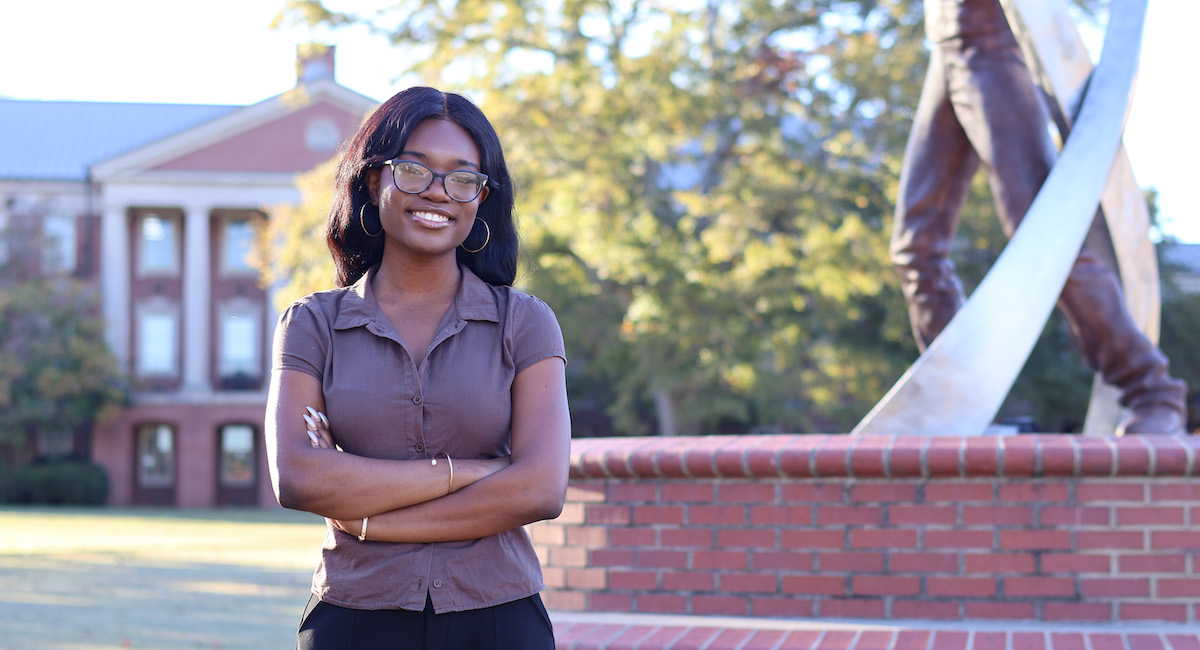
When Presbyterian College senior Alana White arrived at Purdue University for a summer research program, she found herself surrounded by students from some of the nation’s leading research institutions, working in unfamiliar laboratories with sophisticated equipment and tackling scientific questions she had never encountered before.
But the 2026 Goldwater Scholar soon discovered something unexpected: She was more prepared than she realized.
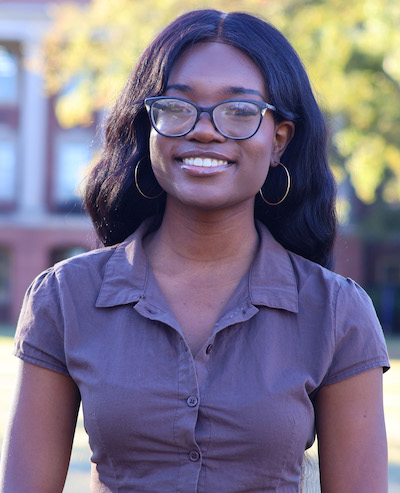
White, a chemistry major and biology minor from Lexington, South Carolina, spent the summer investigating materials that could help scientists develop more efficient ways to produce valuable industrial chemicals. Along the way, she gained experience in advanced laboratory techniques, developed an independent research project and even discovered an unexpected talent for mentoring others.
For White, who became the first Goldwater Scholar in PC history earlier this year, the experience reinforced both her passion for scientific discovery and her appreciation for the undergraduate research opportunities that helped prepare her for it.
“PC definitely prepared me a lot more than I had even realized,” she said.
Breaking New Ground in the Laboratory
White participated in Purdue’s summer undergraduate research program at a center focused on developing innovative approaches to converting hydrocarbons into more valuable chemical products.
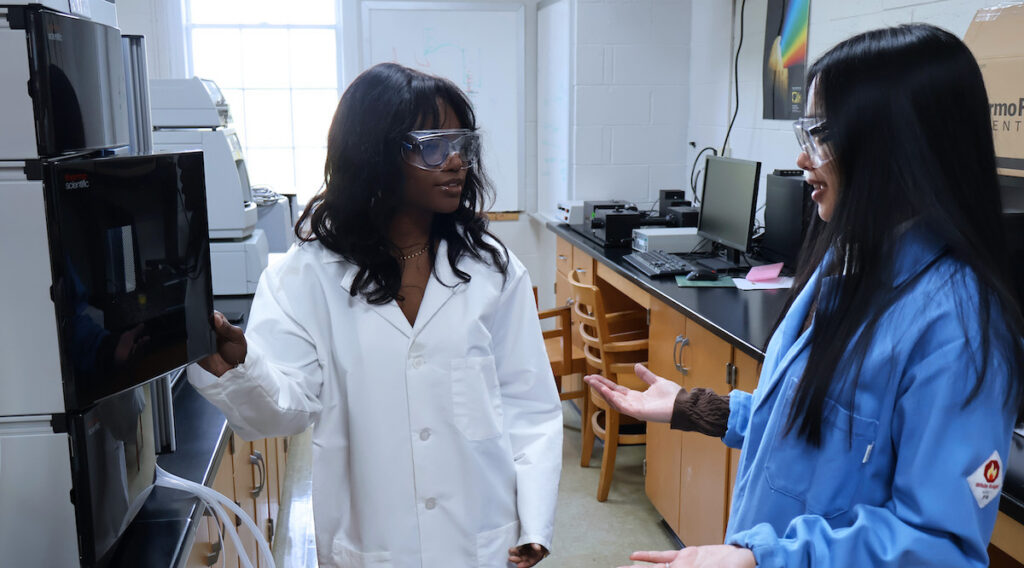
Her assignment involved synthesizing and characterizing zeolites — porous materials that act as catalysts in chemical reactions. The research explored how these materials could support the conversion of light hydrocarbons into chemicals used to manufacture everyday products, including plastics, resins, adhesives, and acrylics.
It was an entirely new field for White, whose previous research at PC focused primarily on microbiology and chemical biology.
“All completely new,” she said. “This was one of the best experiences.”
White was tasked with producing a particular type of catalyst known as zinc MFI zeolite. According to White, no one in her assigned laboratory had previously synthesized that specific material.
Rather than following an established laboratory procedure, she began by studying published scientific literature, evaluating experimental approaches and developing a method of her own.
She eventually synthesized approximately 25 samples before moving into the complex process of characterizing their chemical and structural properties.
“The most challenging part was getting started in general because I didn’t have a foundation to go off of,” she said.
Her work introduced her to sophisticated analytical instruments and methods, including X-ray diffraction, inductively coupled plasma optical emission spectroscopy and nuclear magnetic resonance spectroscopy.
The most rewarding moment came near the end of the program, when results from a crucial analysis confirmed that zinc had been incorporated into the framework of the catalyst — an important objective of her research.
Those findings arrived just days before she was scheduled to submit her presentation for the program’s research symposium.
“We saw that we had framework zinc,” White said. “I felt really accomplished.”
PC definitely prepared me a lot more than I had even realized.”
Alana White ’27
Prepared to Compete
Although Purdue offered access to equipment and facilities beyond those available at a small liberal arts college, White discovered that her experience at PC had given her another valuable advantage: independence.
While working alongside undergraduates from institutions such as the University of California, Berkeley, and Johns Hopkins University, White recognized how much she had benefited from conducting her own research under the direct guidance of PC faculty.
At larger institutions, she observed, undergraduate researchers often assist graduate students with established projects. At PC, she had already experienced the responsibility of helping lead a research investigation from beginning to end.
Working with assistant professor of chemistry Dr. Kimberly De La Cruz and assistant professor of biology Dr. Stuart Gordon, White previously investigated how low concentrations of carbon monoxide affect bacterial responses to antibiotics. That work resulted in a first-author publication in the peer-reviewed journal microPublication Biology.
The experience also taught her to navigate scientific literature, troubleshoot experiments, document findings and communicate results.
Those skills proved invaluable at Purdue.
“I think me being able to already have led one before definitely gave me a lot of confidence that I didn’t even realize I had,” White said.
She credited De La Cruz with emphasizing independent reading, research documentation and technical writing — expectations that prepared her for the demands of a major research university.
Even the extensive written assignments she completed at PC paid dividends.
For White, the experience demonstrated how personalized instruction and meaningful undergraduate research opportunities can prepare students from smaller institutions to succeed in highly competitive scientific environments.
From Student to Mentor
Perhaps the summer’s biggest surprise had little to do with chemistry.
Just three days after arriving at Purdue, White was asked to help mentor a high school science teacher participating in a companion research program for educators.
The assignment initially intimidated her. She was still learning the laboratory procedures herself and had never considered teaching or mentoring among her strengths.
But she approached the responsibility with the same openness that had guided her own research.
Rather than pretending to know every answer, she worked alongside the teacher, acknowledged what she was still learning and sought guidance from her graduate student mentor when necessary.
Over the following month, the teacher progressed from observing experiments to helping White synthesize catalyst samples independently.
Watching that transformation left a lasting impression.
“I never really saw myself as being a good teacher, being a good instructor, or anything like that,” White said.
The teacher later told her that the experience had changed his relationship with science.
His encouragement helped White recognize that she could offer others the same kind of support she had received from faculty mentors at PC.
“I guess I think PC had prepared me a lot to even be a good instructor like that,” she said.
The experience inspired her to pursue additional mentoring opportunities after returning to campus.
A Clearer Path Forward
White’s summer at Purdue also helped sharpen her plans for graduate school and a career in scientific research.
Before the program, much of her experience centered on microbiology and chemical biology. At Purdue, she discovered new interests in materials chemistry, catalysis and the intersection of chemistry and chemical engineering.
Visits to industrial facilities and specialized research centers also helped her see how scientific disciplines intersect in practical applications.
White, who hopes to pursue a Ph.D. and eventually work in industry, said the experience has broadened the range of research programs she is considering while bringing her long-term interests into sharper focus.
It has also strengthened her confidence, even as she acknowledges the uncertainty of competitive graduate school admissions.
Despite her Goldwater Scholarship, peer-reviewed publication and growing research experience, White admitted that she sometimes struggles with feeling as though she does not belong in the laboratory.
Purdue helped challenge those doubts.
Thrown into an unfamiliar environment, she found that the qualities that brought her success at PC — preparation, persistence, curiosity and initiative — remained just as valuable.
More importantly, the summer reaffirmed what she had begun discovering as a sophomore at Presbyterian College, when an organic chemistry course first inspired her to abandon her original plans for pharmacy and pursue research instead.
“I think this summer really made me realize just how much I love research,” she said.
And although her achievements continue to accumulate, White believes success in research ultimately depends on something more fundamental than awards or academic credentials.
“I think all you just need is a willingness to be there, a drive to be there,” she said.