New analysis shows PC’s continuing role as a significant economic driver and its far-reaching influence
A new study conducted in Presbyterian College’s Economics and Business Administration Department has confirmed what local residents have long believed — that PC plays a vital role in sustaining the economy of Laurens County.
Under the supervision of assistant professor of accounting Scott Barker, senior economics student Emma Erwin measured the institution’s total financial footprint across the county, including spending by faculty, staff, students and visitors, as well as institutional operations and community investments.
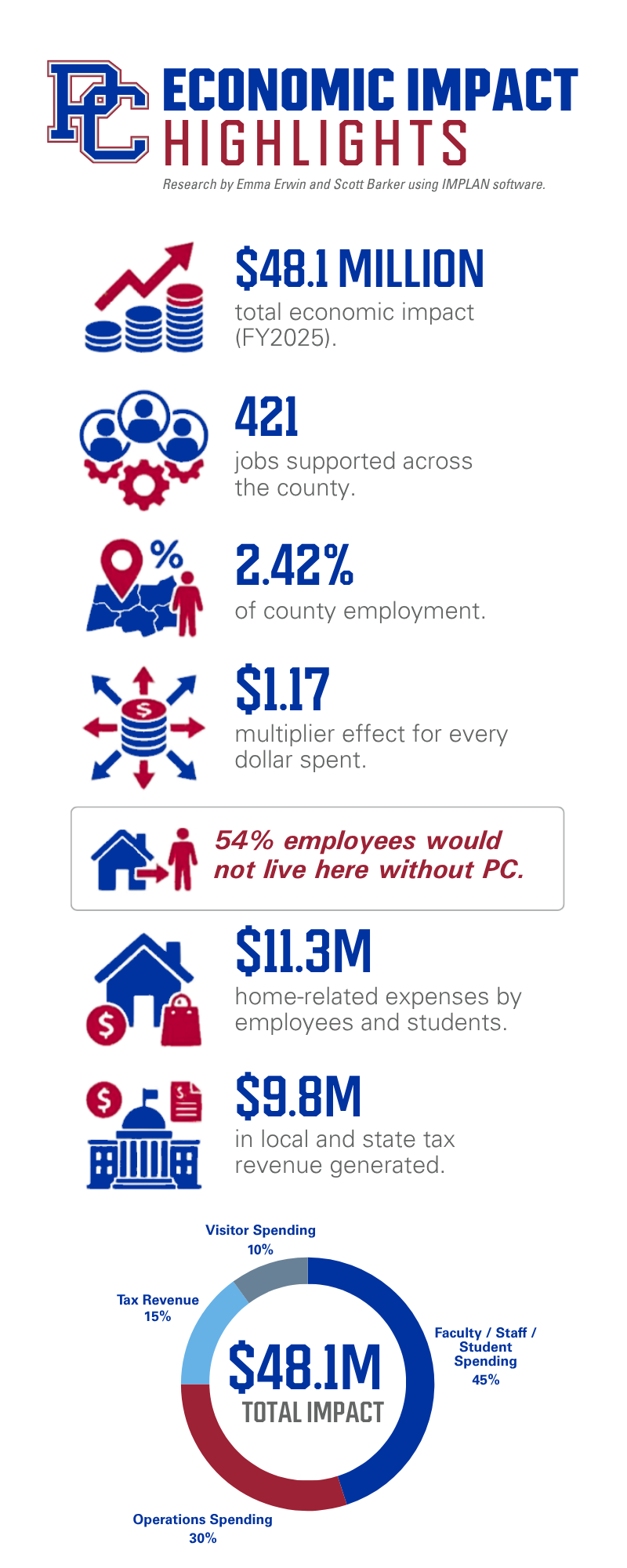
According to the study, PC contributed an estimated $48.1 million to the Laurens County economy during fiscal year 2025, supporting 421 jobs countywide — nearly 2.5% of all employment in the county.
The college directly employs 305 faculty and staff members, with an additional 116 jobs supported through indirect and induced economic effects. The research found that 54% of PC employees would not live in Laurens County without their college employment, underscoring the institution’s role as a population anchor for the region.
Understanding the numbers
The $48.1 million figure represents a conservative and precise measurement using new technology to produce precise data.
“Think of it like measuring your house with a yardstick versus a laser measure,” Barker said.
The 2025 study employed strict geographic boundaries, counting only purchases made from businesses physically located in Laurens County. Earlier research included some spending that occurred in neighboring counties. Additionally, Erwin’s analysis used updated economic modeling software with more conservative multiplier effects — the ripple impact that occurs when money circulates through the local economy.
The COVID-19 pandemic also fundamentally altered spending patterns between 2018 and 2025, Barker noted. Supply chains shifted, remote work increased and consumer behavior changed in ways that affect how dollars flow through rural economies.
“What’s most important is that Presbyterian College continues to be one of the largest and most stable economic forces in Laurens County,” Barker said. “The college directly employs more than 300 people, supports more than 400 jobs total and generates roughly $682 in economic activity for every man, woman and child in the county. That’s a substantial and continuing commitment to this community.”
Building on a legacy of scholarship
The results build upon earlier studies conducted under the guidance of professor emeritus Norman Scarborough, a longtime professor of business and entrepreneurship whose student researchers first began quantifying PC’s local impact more than a decade ago.
Presbyterian College’s record of analyzing its economic impact began in 2013, when Scarborough and a team of students conducted pioneering studies on the School of Pharmacy and the College of Arts and Sciences.
Those early studies categorized PC’s influence in three tiers:
- Direct effects, such as payroll and institutional spending;
- Indirect effects, the ripple impact of local purchasing and contracting; and
- Induced effects, the additional household spending that stems from wages earned by those who benefit from the first two categories.
Scarborough explained the significance succinctly at the time.
“I shudder to think what the local economy would be like without the college here,” he stated.
The project set a precedent for hands-on learning and community partnership — hallmarks of Presbyterian College’s business and economics program.
A recognized cornerstone of Clinton’s economy
Independent data from the City of Clinton has long reinforced Presbyterian College’s role as an economic cornerstone.
The City of Clinton Comprehensive Annual Financial Report (2014) identified PC as one of the community’s largest institutional employers and utility customers, along with the Presbyterian Home and the Whitten Center.
While that report did not assign dollar values to the college’s contributions, it recognized Presbyterian College as a stabilizing presence in the city’s fiscal health — a steady partner through cycles of economic expansion and contraction.

Where the money goes
Erwin’s research revealed that PC’s economic influence touches nearly every sector of the local economy.
Her study drew from surveys of 101 undergraduate students, 64 graduate students and 102 faculty and staff members, combined with detailed institutional expenditure data from the college’s Office of the Controller. She employed IMPLAN software — the industry standard for economic impact analysis — using 2024 data for Laurens County.
The analysis found that spending breaks down into two major categories: $34.6 million from faculty, staff and student expenditures, and $13.5 million from institutional operations.
The largest spending categories include tax payments ($12.6 million), home-related expenses such as mortgages, utilities and repairs ($11.3 million), and food purchases at restaurants and grocery stores ($3.7 million). Additional spending supports transportation, retail, recreation, medical services and insurance providers throughout the county.
Graduate students, despite comprising just 242 of the college’s 1,095 total enrollment, contribute $8.8 million annually to the local economy — more than double the $4.3 million generated by 853 undergraduate students. The difference reflects graduate students’ higher likelihood of living off campus and maintaining households in the community.
The study also quantified visitor spending, estimating that out-of-town guests staying with PC students and employees contribute an additional $314,000 annually to local hotels, restaurants and retail establishments. Erwin’s study did not include data on the economic impact of Division 1 athletics at PC, however – which means the economic impact of sports at PC drives that number even higher.
According to the analysis, every dollar Presbyterian College spends in Laurens County generates approximately $1.17 in total economic output — a multiplier effect typical of rural counties where many goods and services are sourced from outside the immediate region.
For nearly 150 years, Presbyterian College has stood alongside the City of Clinton as a partner in growth and service. This research confirms what we see every day — that the college and the community thrive together. Our students, faculty and staff don’t just work and learn here; they invest their time, energy and resources to make Laurens County stronger.”
Dr. Anita Gustafson, PC President
College leaders praise student research
Presbyterian College president Dr. Anita Gustafson said the findings highlight both the rigor of the college’s academic programs and the enduring partnership between PC and the people of Laurens County.
“Emma Erwin’s research represents exactly the kind of hands-on, community-engaged scholarship that defines a Presbyterian College education,” Gustafson said. “Her work demonstrates that our students don’t just study economic theory — they apply it to real-world questions that matter to our neighbors and community partners.”
Gustafson added that the study reaffirms the college’s deep roots in Laurens County.
“For nearly 150 years, Presbyterian College has stood alongside the City of Clinton as a partner in growth and service,” she said. “This research confirms what we see every day — that the college and the community thrive together. Our students, faculty and staff don’t just work and learn here; they invest their time, energy and resources to make Laurens County stronger.”
She noted that the economic impact extends beyond measurable dollars to include community service, cultural enrichment and educational partnerships that enhance quality of life throughout the region.
Impact beyond economics
While Erwin’s study focuses on measurable economic outcomes, Presbyterian College’s influence reaches much further — into the daily life and spirit of Laurens County. The college’s longstanding culture of service strengthens local communities, builds partnerships and amplifies its positive effect on the region.
Each year, hundreds of students and faculty members participate in Fall Service Day, working alongside local organizations such as Springdale Methodist Church, the Humane Society, the Clinton Community Garden and the Laurens County Public Library Garden to beautify shared spaces and lend helping hands. These volunteer efforts not only assist local nonprofits but also foster civic pride and stronger town-gown relationships across the county.
New students are introduced to PC’s service ethic from the moment they arrive on campus through the Rise Against Hunger project sponsored by First Presbyterian Church of Clinton that brings students and residents together to package thousands of meals for families facing food insecurity around the world.
And when crisis strikes, that same spirit shines brightest. In the aftermath of Hurricane Helene in 2024, more than 200 Presbyterian College students volunteered in neighborhoods across Clinton and beyond, clearing debris, aiding residents and embodying the college’s enduring motto — “While We Live, We Serve.”
These efforts, though not quantified in the new economic study, represent a different kind of investment — one measured in human connection, community trust and collective resilience. Together, they reveal that Presbyterian College’s impact on Laurens County is as much about service and stewardship as it is about economic strength.
A foundation for continued growth
Erwin’s report concludes that Presbyterian College remains one of the largest and most stable contributors to Laurens County’s economy, providing a foundation for continued regional development.
The $48.1 million annual impact represents approximately $682 for every resident of Laurens County’s estimated population of 70,545. The 421 jobs supported by PC represent 1.4% of county employment, with the college’s 305 direct employees accounting for another 1.02% — a combined employment impact of 2.42%.
The study notes that PC’s influence is particularly significant given Laurens County’s ongoing economic transition away from traditional textile manufacturing toward advanced manufacturing, logistics and service industries.
As the research demonstrates, PC’s motto — “While We Live, We Serve” — extends far beyond the classroom. It is reflected in every paycheck issued, every student meal purchased, every renovation project launched and every event that brings visitors to downtown Clinton.
By continuing to quantify its impact and share that information with the public, Presbyterian College reaffirms its role not only as an academic institution but as a cornerstone of the Laurens County economy — one that remains as vital today as it was when its first students walked through its doors in 1880.