Dr. Matteel Knowles connects history, personal transformation, and leadership in campus address
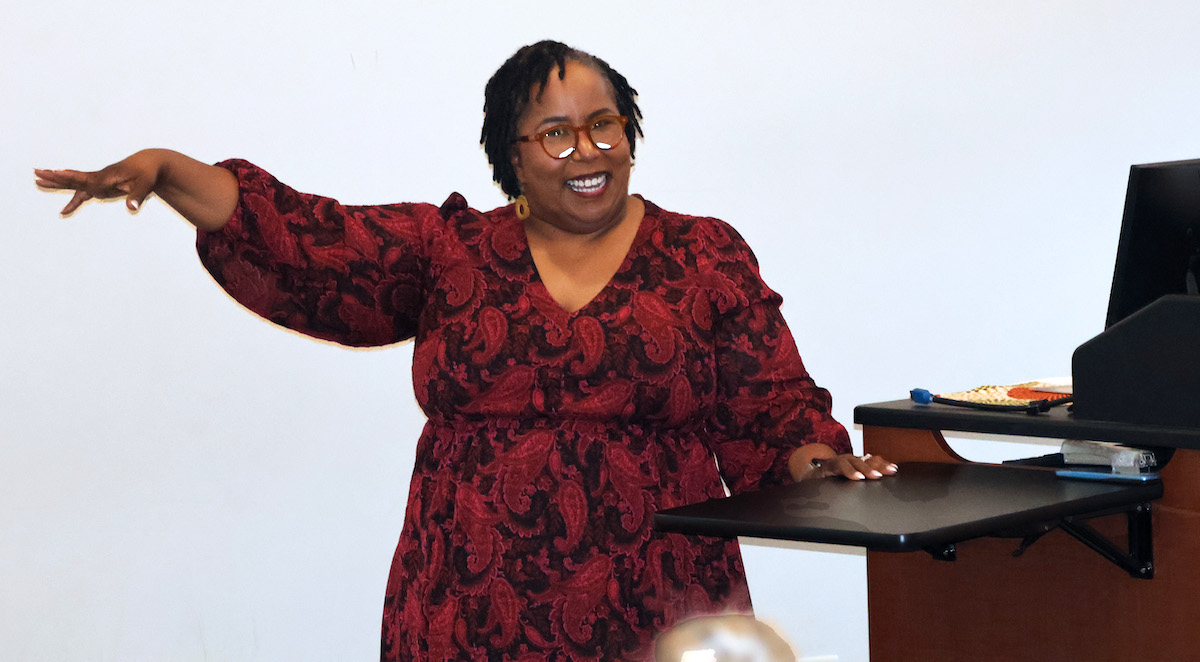
Author and motivational speaker Dr. Matteel Knowles challenged listeners to rethink the legacy of Harriet Tubman during a Women’s History Month lecture at Presbyterian College, urging her audience to see the famed abolitionist not only as a historical figure, but as a model for leadership, collaboration, and personal transformation.
A retired professional with more than 30 years in higher education, the founder of Matteel Speaks LLC, said Tubman continues to be a source of inspiration.
“Most of you have heard about Harriet Tubman,” Knowles said. “We’re going to go beyond that and talk about the woman.”
A life shaped by hardship — and resolve
Knowles traced Tubman’s life from her birth as Araminta Ross in Maryland in the early 1820s, emphasizing the brutal realities of slavery, including family separation and physical abuse.
“She was born into a system designed to deny her humanity,” Knowles said, urging listeners to consider what Tubman achieved despite those conditions.
Tubman endured severe hardship as a child, including a traumatic head injury that caused lifelong health complications. Knowles noted that Tubman later viewed the resulting visions and dreams as a source of spiritual guidance.
That resilience culminated in Tubman’s decision to escape slavery—an act Knowles framed as both physical and mental courage.
“The decision starts here,” she said. “It was either keep going or die.”
Now is not the time to shrink in fear. Now is the time to be collaborative, to build community, to use our voices.”
Dr. Matteel Knowles, founder of Matteel Speaks LLC
Freedom through collaboration

Central to Knowles’ message was the idea that Tubman’s success was rooted in collaboration.
“No one does it alone,” she said, describing the network of allies who supported Tubman along the Underground Railroad.
Those allies included abolitionists such as William Still, Thomas Garrett, and Frederick Douglass—individuals from different racial, social, and religious backgrounds united by a shared belief in human dignity.
Tubman made multiple trips back into the South to guide enslaved people to freedom, rescuing nearly 300 individuals over time, Knowles said.
Leadership beyond the Underground Railroad
Knowles encouraged the audience to look beyond Tubman’s most famous role.
She highlighted Tubman’s service during the Civil War as a nurse, scout, and spy, as well as her work in the women’s suffrage movement.
“She made sure the Black female voice was not lost,” Knowles said, noting that Tubman became a powerful public speaker despite not being formally educated.
Later in life, Tubman purchased property in New York and established a home for elderly and formerly enslaved individuals—continuing her lifelong commitment to community and care.
A personal journey of rediscovery
Knowles wove her own story into the lecture, reflecting on her career in higher education and the challenges she faced as she advanced into leadership roles.
At one point, she said, she began to withdraw and stopped using her voice.
“I got quieter,” she said. “I didn’t show up as the best version of myself.”
After taking time to reflect and heal, Knowles ultimately chose to retire and pursue a new path focused on helping others find their voice and purpose.
“Now I get to pour back into other people,” she said.
A call to act with courage
Throughout the lecture, Knowles challenged attendees to apply Tubman’s example to their own lives.
She encouraged them to reflect on where they are being called to build relationships, bridge divides, and lead with courage.
“Now is not the time to shrink in fear,” she said. “Now is the time to be collaborative, to build community, to use our voices.”
A legacy that endures
More than a century after her death in 1913, Tubman’s influence continues to resonate, Knowles said.
“Her legacy is still feeding us,” she said.
She closed with a challenge to the audience:
“What’s one bold step you will take?”