A question in Dr. Mike Rischbieter’s paleontology class led Jeremiah Stichnoth ’28 from the PC classroom to hands-on fieldwork in Wyoming
Sometimes, opportunity begins with simply raising your hand.
For Presbyterian College biology major Jeremiah Stichnoth ’28, that moment came during a paleontology class taught by Dr. Mike Rischbieter, the Charles A. Dana Professor of Biology. Rischbieter was telling his students about a colleague who would be leading a fossil excavation in Wyoming last summer.
Stichnoth heard “fossil dig” and “Wyoming” and decided there was only one reasonable response.
“I raised my hand and asked if said colleague needed any workers,” he said.
Rischbieter did not know. But he offered to find out.
The next day, Stichnoth had his answer: Dr. Kent Sundell, Rischbieter’s colleague, would be happy to hire him for the summer.
“All I knew was dinosaurs and Wyoming,” Stichnoth said, “and that’s all I needed to know.”
That brief exchange illustrates something Stichnoth has discovered during his time at PC: When students are willing to pursue their interests, professors are close enough to notice — and willing to help them find opportunities to take those interests beyond the classroom.
“It was obvious from the first day of my paleontology class that Jeremiah loved fossils,” Rischbieter said. “He knew more of the names of the various fossil beasts he had learned about than I did! So I had to study a bit more than usual, as he was always asking challenging questions, which made the class for the students and me actually more interesting.
“By the time we had made it through a variety of labs and the students had learned a number of paleontology lab skills and other information, I knew that Jeremiah would be ready for a field experience, and when I told the class about a colleague of mine that was operating fossil excavation quarries out in Wyoming, and would anyone be interested in learning more about it, Jeremiah’s hand was the first to go up!”
From Classroom Curiosity to Field Experience
The Abbeville, S.C., native came to PC already knowing that biology was where he belonged.
His inspiration goes back to childhood and the late wildlife conservationist and television personality Steve Irwin.
“I’ve wanted to be like Steve Irwin since I was a kid,” Stichnoth said. “Unfortunately, I can’t convert to being Australian. However, I can get a job that lets me work with wildlife, so that’s why I’m a bio major.”
That sense of humor remained intact even during a summer that demanded long days and hard physical work.
The experience was one of the most fulfilling things I’ve done so far.”
Jeremiah Stichnoth ’28
Because of confidentiality requirements surrounding the excavation, Stichnoth cannot identify the specific location of the dig or the dinosaur being excavated. But he can talk about what it was like to spend his summer doing the kind of work he had previously encountered primarily in a classroom.
“The experience was one of the most fulfilling things I’ve done so far,” he said.
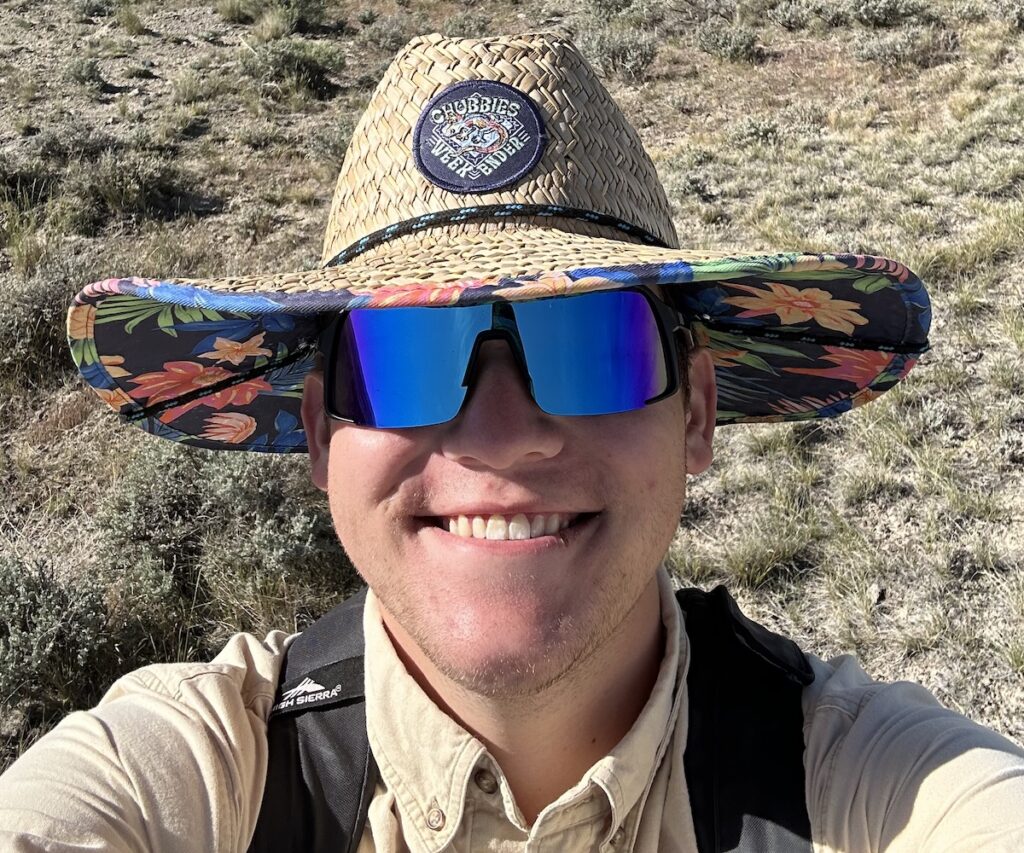
His days began early. Stichnoth and his co-workers met at the preparation lab at 6 a.m. Mountain Time before traveling together to the excavation site. They typically arrived around 7:15 a.m. and began digging with shovels and hand tools.
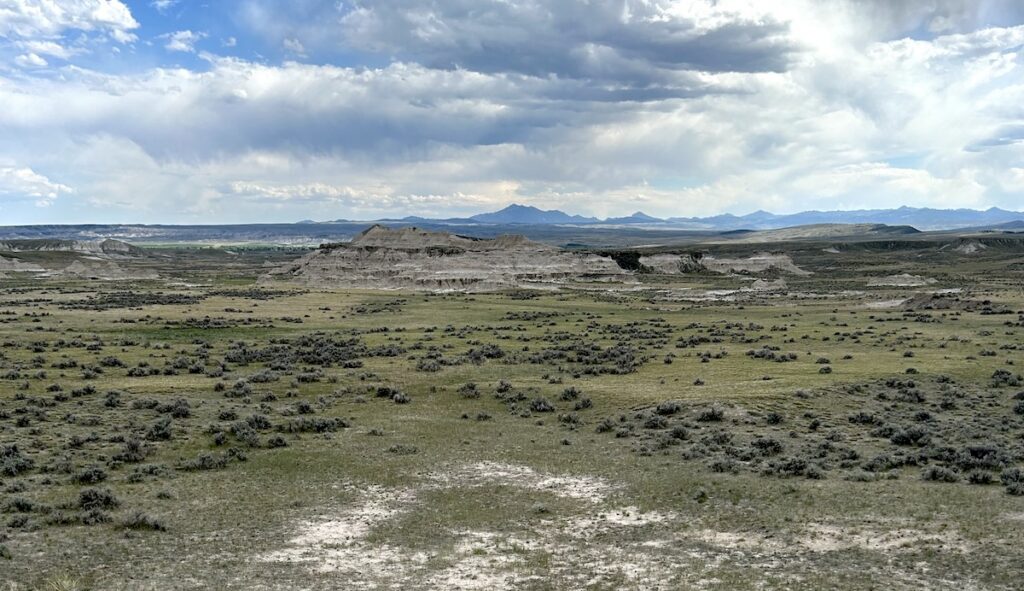
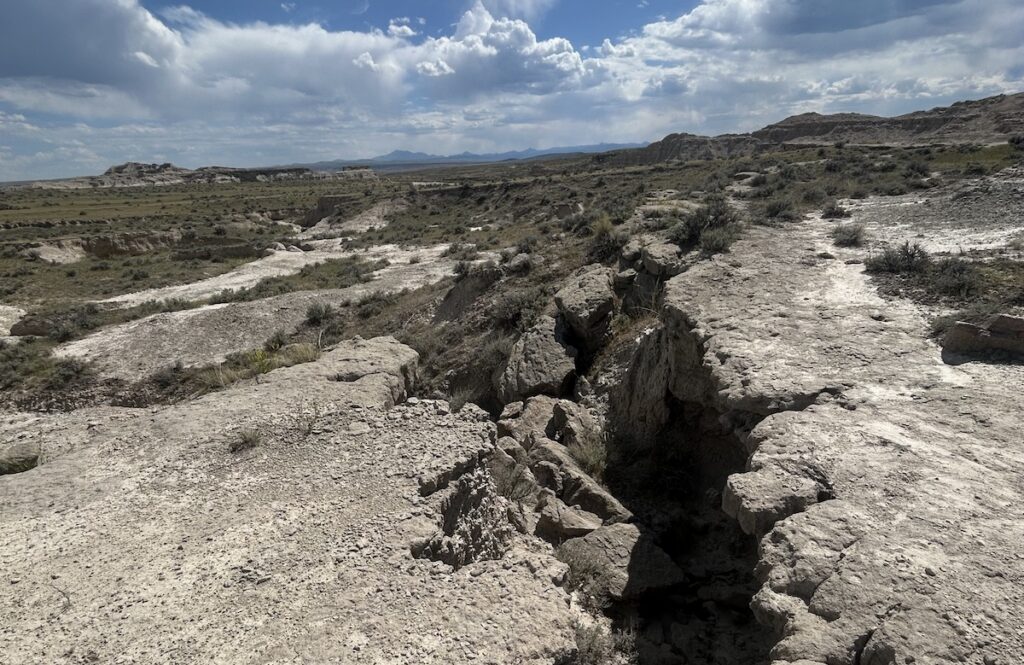
The work gave Stichnoth firsthand exposure to a landscape vastly different from the one he was standing on millions of years later. Evidence from the site indicated that the area had been a swamp roughly 80 million years ago.
During the excavation, Stichnoth encountered gar scales, crocodile teeth and scutes, fish teeth, hadrosaur teeth, Triceratops teeth and bones, and abundant fossilized plant material.
He also learned some practical lessons about the painstaking work of handling fossils — including the remarkable effectiveness of cyanoacrylate adhesive, which is used to stabilize fragile material.
“The most common thing I observed was people gluing themselves to things,” he joked. “Cyanoacrylate sets very fast.”
A Professor — and Then a Colleague
The summer also reinforced for Stichnoth the importance of the faculty relationship that helped put him there in the first place.
“Being in his paleo class is literally what got me the job,” Stichnoth said of Rischbieter, before adding, “and my irresistible charm.”
But Rischbieter’s influence extended beyond making an introduction.
Stichnoth said the course gave him knowledge that prepared him for the experience, while his relationship with his professor also began to evolve as he gained experience of his own.
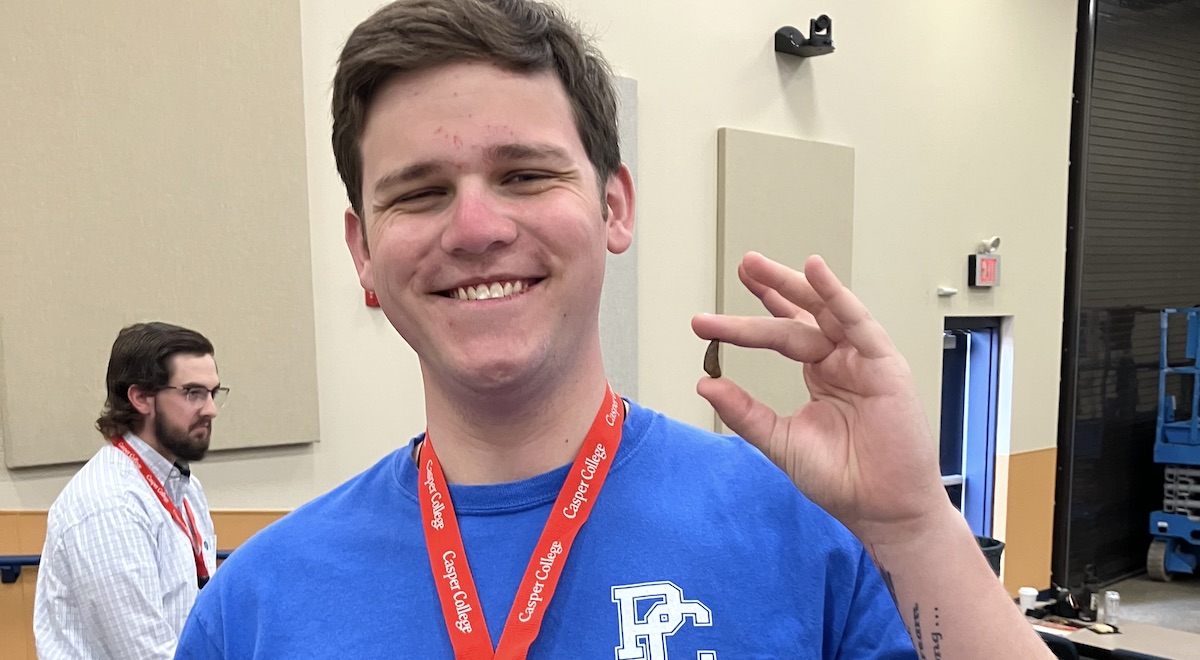
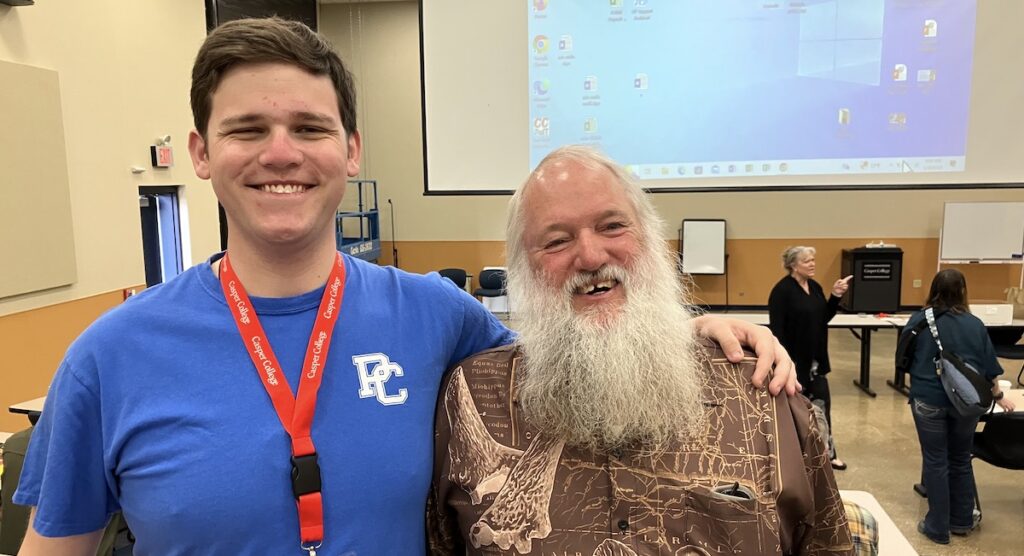
At the beginning of June, Stichnoth and Rischbieter met again at the annual Tate Museum Conference in Casper, Wyo.
“He treated me more like a respected colleague than a student,” Stichnoth said. “Seeing his pride in me was awesome.”
That transition — from student learning from a professor to young scientist beginning to participate in the same professional community — is one of the most meaningful parts of the experience for Stichnoth. And for Rischbieter.
“I actually couldn’t wait to get to the Tate Conference in Casper to see how Jeremiah had been doing because having done extensive quarry work in places like Oklahoma, Texas, and Wyoming, there was no way to prepare him for everything. But when I saw him at the conference, he looked professional and fit, and the quarry master person who oversees the entire operation was effusive with praise over Jeremiah’s work ethic. In fact, she said he was the best ‘digger’ she had ever run across.”
Rischbieter said it was more than being good at digging, though.
“Jeremiah was also able to see a variety of professionals in biology, paleontology and geology give technical talks on a variety of subjects,” he said. “Some of these speakers were master’s and Ph.D. students, and I had the feeling that within a few years I would see Jeremiah in that same position. He has the interest and excitement that I think would carry him into the future as a top notch paleontologist.
And Stichnoth’s experience may open doors for other PC students as well.
Rischbieter said interest among students has grown after hearing about Stichnoth’s summer in Wyoming, with others already expressing an interest in pursuing similar field opportunities.
“On the first day of class this year I told the class that a student that was in one of their seats last year had spent the entire summer working in a fossil quarry in Wyoming, armed with the information and techniques they would learn in the coming semester,” Rischbieter said. “I have already had three students ask about opportunities for this coming summer!”
Growing Into the Opportunity
For Stichnoth, the experience also demonstrated how much he has changed since arriving at Presbyterian College.
He readily admits that the work ethic required for long days at an excavation site was not something he always possessed.
“I was kind of a lazy student in high school,” he said, “but PC helped me develop the strong work ethic that allowed me to excel here.”
That growth may be as important as any fossil he uncovered.
At PC, Stichnoth has found professors who challenge him academically, recognize his interests and encourage him to act on them. In turn, he has learned to take greater responsibility for where those interests might lead.
In this case, the journey began not with a formal internship application or a carefully mapped career plan, but with a student listening to his professor tell a story and having enough curiosity — and confidence — to raise his hand.
“One of the most valuable aspects of attending PC is the incredible opportunity to do real scientific research alongside faculty,” said Rischbieter. “We have an extraordinary group of professors in Lassiter and Richardson Halls who work with students every single day. The scope of what you can study here is amazing—one day you’re looking at the intricacies of DNA, the next you’re out in the field with living organisms, or even digging into the past to study fossils of animals that roamed the ancient world
Looking Toward a Life in Biology
Stichnoth does not yet know exactly where his career will take him, but he knows biology will remain at its center.
After graduating from PC, he hopes to attend the University of Georgia to earn a master’s degree in ecology. Another possibility is working with the school-year educational program at St. Christopher Camp and Conference Center, where he could help teach others about the ecology of barrier islands.
Beyond that, he is comfortable leaving some possibilities open.
But there is one role he can already imagine for himself later in life: becoming a college biology professor.
“I’ve always loved sharing my passion and enthusiasm with people,” Stichnoth said.
It would, in some ways, complete the circle.
A professor sharing his own enthusiasm for paleontology helped a PC student discover an opportunity he might otherwise never have known existed. Stichnoth took it from there — first by raising his hand, then by traveling west and putting what he had learned to work.
Someday, he hopes to be the professor on the other side of that conversation, sharing his own enthusiasm with another student who may simply need someone to notice an interest — and help open a door.