One hot, muggy afternoon in Belize City this June, it started raining outside an occupational therapy clinic — and it didn’t stop.
Inside were six Presbyterian College Occupational Therapy Doctoral Program students, three faculty members and a lobby full of Belizean families awaiting services.
“If you asked me for the one afternoon I am most thankful for, it is the day it rained,” said Dr. Allie Turner, academic fieldwork coordinator for PC’s Occupational Therapy Doctoral Program.
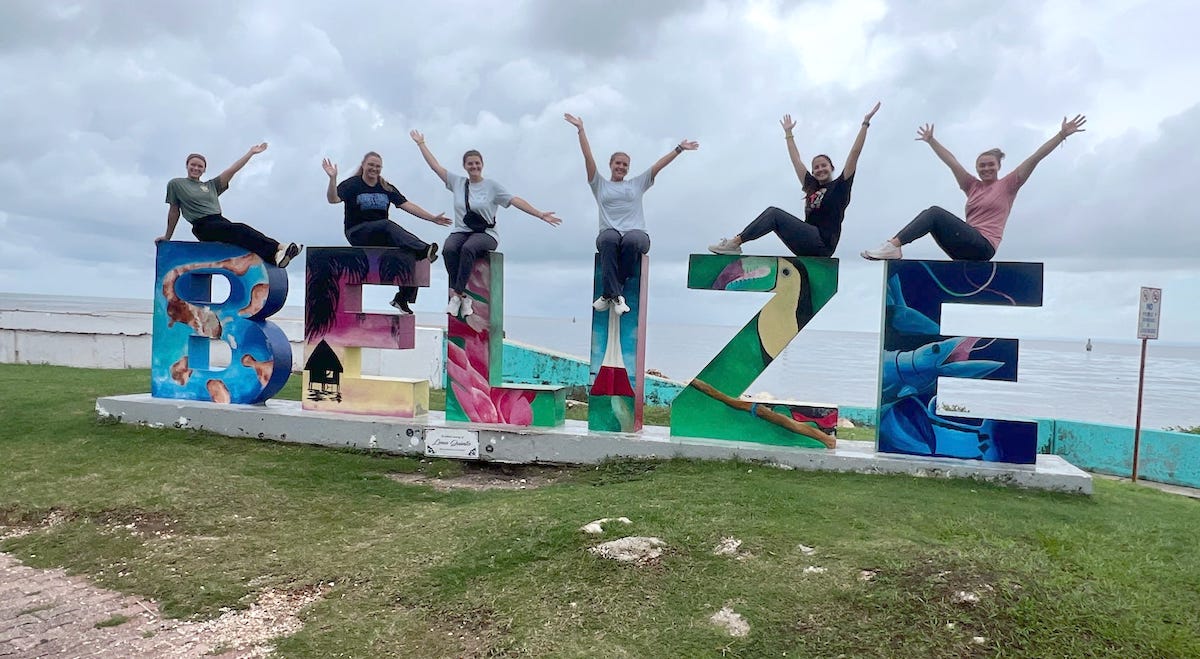
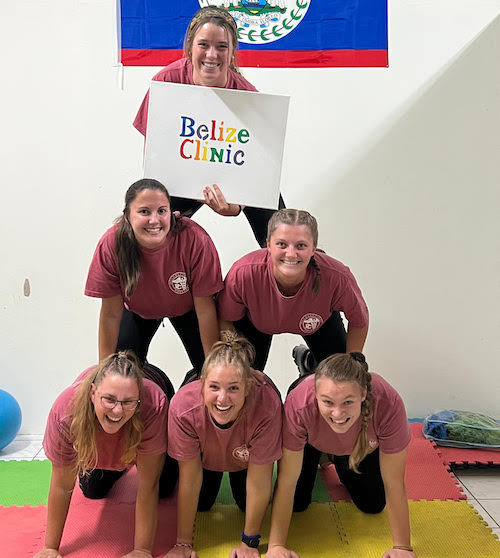
Turner, along with faculty members Dr. Christine Boone and Dr. Courtney Addison and six students, traveled to Belize City for a week of Level I fieldwork with Therapy Volunteers International.
“Our families had walked to the clinic, and once the rain came, there was no walking home. So they stayed,” Turner said. “Parents filled the lobby waiting for it to pass, and we were lucky enough to wait with them.
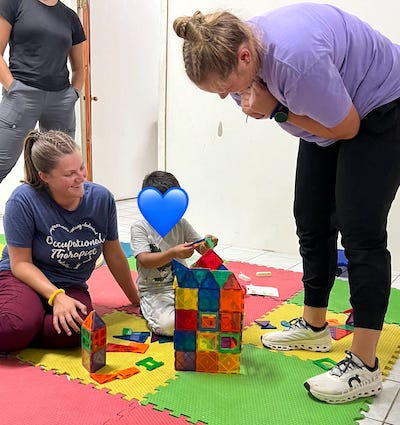
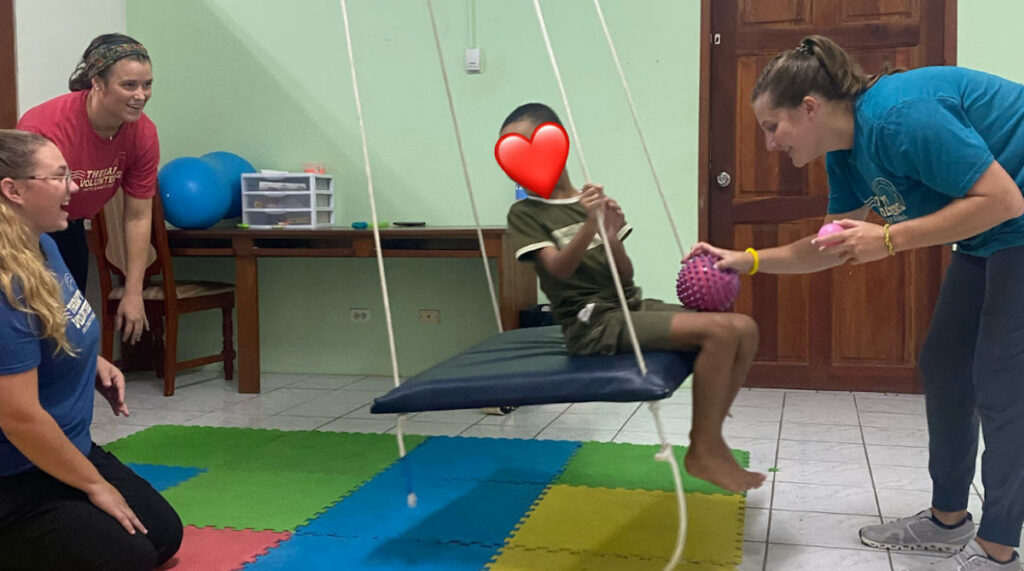
“Nothing in that room was on schedule. We played with the children. We talked with the parents. The families talked with each other and looked after one another. And our students, without being told to, kept working. They watched how a child managed an unfamiliar space, how siblings negotiated a shared toy, how a mother described her son’s routine when she was not being asked a formal question.
“No structure, no written goals, no billable unit, and yet by the time the rain stopped, we understood those children and families better than we had that morning.”
Putting Classroom Lessons Into Practice
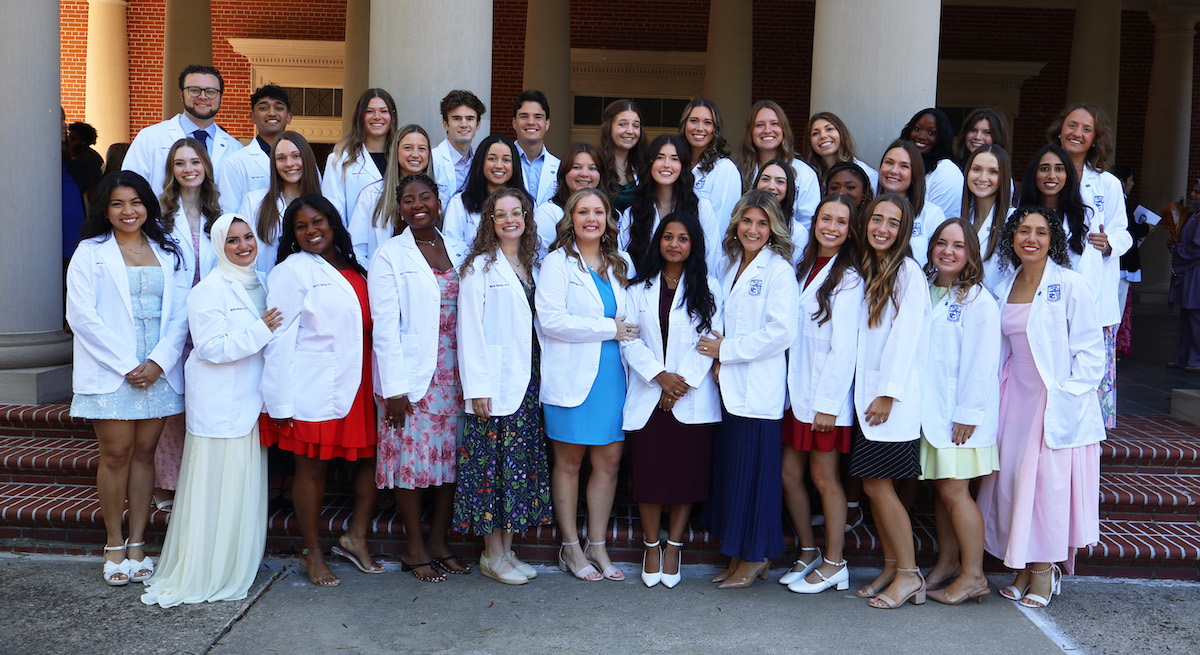
Alongside Boone, Addison and Turner, PC-OTD students Morgan Norris, Alexis Owens, Rylee Kitchens, Rebecca O’Neal, Mackenzie Dilworth and Elainee Reagan participated in occupational therapy screenings, interventions, group-based sessions and teacher and parent training as part of their supervised fieldwork experience.
Their academic goal was specific: complete Level I fieldwork, where students begin moving from studying the occupational therapy process in the classroom to applying it with real people in real environments.
“Experiences like this bring occupational therapy education to life,” Addison said. “Students can learn theories, assessments, interventions, cultural humility, and clinical reasoning in the classroom, but there is something incredibly powerful about having to apply those concepts with a real person, in a real environment, where the answer is not written in a textbook.”
In Belize, the answers often were not clear-cut. Students had to assess situations, adapt to unfamiliar circumstances and begin seeing themselves less as students and more as future occupational therapists.
But before the clinical work began, faculty wanted them to understand the country and community they would be serving.
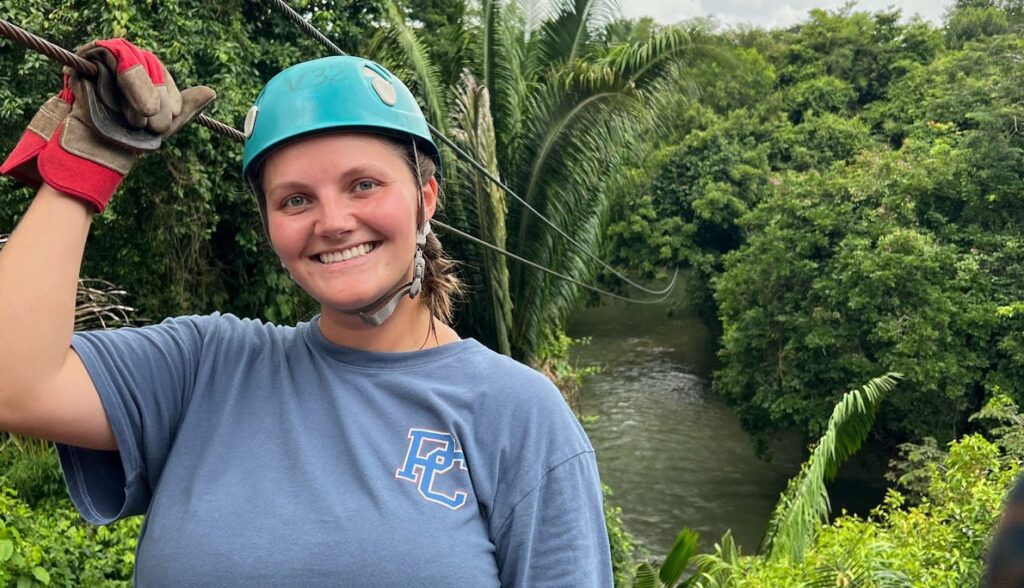
After arriving, the group spent time experiencing Belize through cave tubing, zip-lining, local cuisine and other cultural activities. Therapy Volunteers International also provided cultural orientation and clinical preparation before the group began working with patients.
“We landed and did not go straight to the clinic, and I am thankful we did not,” Turner said. “That was on purpose. You cannot screen a child well in a context you have never experienced, and we wanted these students to know something of Belize and its people before they met anyone as a client.”
As Turner put it, “We were handed the country before we were handed a caseload.”
Learning to See the Whole Person
For O’Neal ’27, fieldwork made lessons about accessibility more tangible.
In Belize City, she saw firsthand how access to health care, financial resources, transportation, education and community resources can affect a person’s ability to receive services.
“Seeing this firsthand helped me understand how important it is for OTs to consider the person and their environment from a holistic perspective rather than focusing only on a diagnosis,” O’Neal said.
She said she returned home with a greater appreciation for “the importance of accessibility, cultural awareness, and adaptability in healthcare.”
Kitchens ’27 also saw how important relationships are to effective therapy. She recalled one moment when she began gaining the trust of a child and establishing a positive rapport.
“That moment reminded me that before we can truly help someone, we have to build a relationship with them,” Kitchens said. “It was a small moment, but it meant a lot to me and reinforced why I chose occupational therapy.”
For Kitchens, the experience also demonstrated that meaningful therapy does not necessarily depend on extensive resources.
“These trips allow us to put what we learn in the classroom into practice while serving others,” she said. “The root of PC is ‘while we live, we serve,’ and this experience allowed me to truly put that into action. It also helped me develop cultural awareness, adaptability, and clinical reasoning.”
Rylee Kitchens, PC Occupational Therapy Doctoral Student
Adapting When Resources are Limited
Helping students learn to adapt was one of Addison’s goals for the trip.
“One of the challenges of international service work is learning to practice effectively when resources, environments, routines, and expectations may be different from what we are accustomed to in the United States,” she said. “However, those challenges often became some of our greatest teaching opportunities.
“Instead of focusing on what we did not have, we learned to ask, ‘What do we have, and how can we use it meaningfully?’”
Addison watched students move from uncertainty toward greater confidence as they learned to try, reflect, adjust, and problem-solve.
Ultimately, she said, the experience reinforced one of occupational therapy’s fundamental principles: meet people where they are.
“It reinforced the importance of listening before intervening, considering the entire context of a person’s life, and recognizing that meaningful intervention does not always require expensive equipment or ideal circumstances,” Addison said. “Sometimes our greatest tools are our ability to observe, educate, adapt, problem-solve, and build relationships.”
For Dilworth ’27, listening to and learning from Belizean families was one of the most memorable parts of the experience.
“Everyone we interacted with was very welcoming and friendly, and I enjoyed learning about the culture and seeing what everyday life looked like for the people in the community,” she said.
The experience also pushed Dilworth beyond her comfort zone and made her more confident in unfamiliar situations.
“Sometimes you have to step outside of your comfort zone to grow,” she said.
Compassion as a Clinical Skill
For Turner, one theme emerged repeatedly throughout the week: compassion.
She saw it in the families who waited together when the rain disrupted their plans. She saw it in the students who continued working when schedules changed. And she saw it in the Clinton community whose fundraising helped make the trip possible.
“Once I saw it, I could not stop seeing it,” Turner said. “The parents who walked to the clinic and then sat with one another while they waited. The families who had so little and still made room to welcome us. Our students, who assessed whoever arrived when the schedule fell apart. The community back home that ate a lot of spaghetti so these six could go.”
For Turner, compassion is not simply a desirable personal quality. It is part of becoming an effective occupational therapist.
“It is not a soft word,” she said. “Compassion is what you have left when the plan is gone, and our plan was gone by the second morning. It also turns out to be a clinical skill: you cannot gather an honest occupational profile from a family that does not feel safe with you.”w
Kitchens said the experience also reflected Presbyterian College’s motto, “While We Live, We Serve.”
“These trips allow us to put what we learn in the classroom into practice while serving others,” she said. “The root of PC is ‘while we live, we serve,’ and this experience allowed me to truly put that into action. It also helped me develop cultural awareness, adaptability, and clinical reasoning.”
Dilworth said completing fieldwork abroad gave her experiences she could not have gained solely in a classroom.
“Overall, my PC Abroad experience in Belize was something I will always remember,” she said. “It gave me experiences that I would not have been able to get in a classroom and helped me grow both personally and as an OT student. I would definitely encourage other PC-OTD students to take advantage of opportunities like this if they are able to.”
A Community Made the Journey Possible
The students’ trip was supported by people both in Belize and at home.
In Belize, clinic staff, local partners, artisans and van drivers helped facilitate the experience. In Clinton, supporters attended karaoke fundraisers at The Lumberyard, participated in yard sales and bought spaghetti plates to help raise money for the six students’ travel.
Therapy Volunteers International coordinated the clinical experience and worked with the PC group throughout its time in Belize.
For Turner, the support from both communities made the experience especially meaningful.
“Six students went to Belize because a small town in South Carolina bought a lot of spaghetti,” she said. “They came home better clinicians. I am grateful beyond words that we were given the time, and I would do it again tomorrow.”