Record Korea Scholars cohort highlights a growing network of language study, international partnerships, and transformative experiences across East Asia
Presbyterian College’s Center for South Korean and Asian Studies is entering a new phase of growth — expanding opportunities for students to study languages, travel abroad, build international relationships and experience Asia through the broad lens of a liberal arts education.
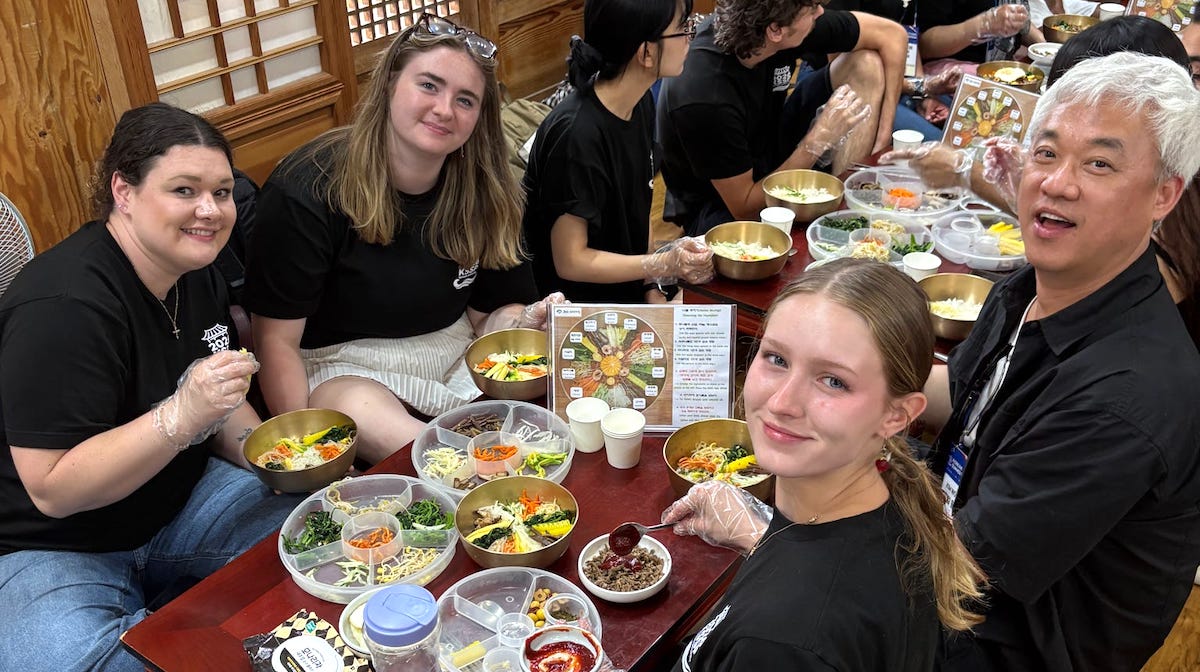
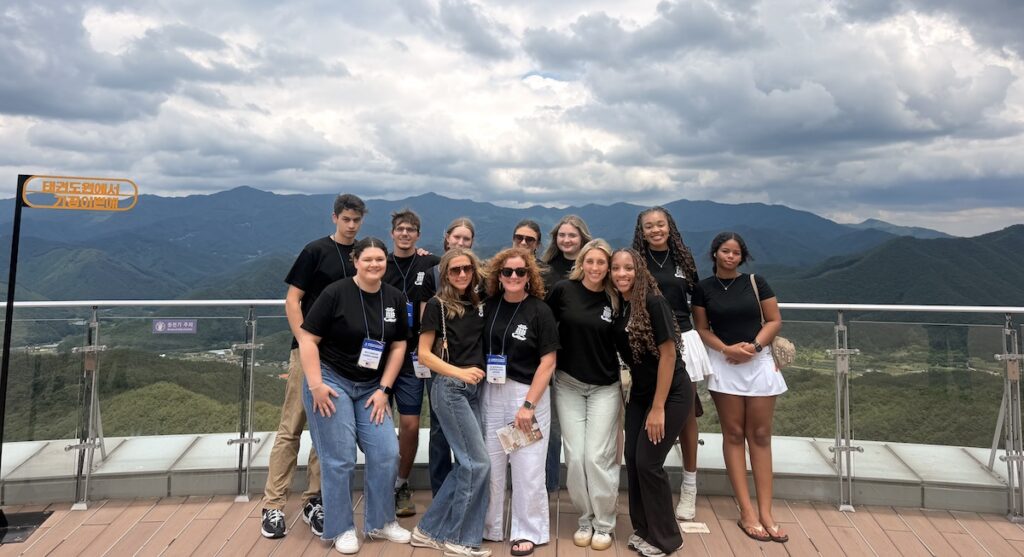
That momentum was especially visible last summer, when PC sent its largest group yet to the Korea Summer Studies Program at Hannam University in Daejeon. Eleven students spent three weeks studying, traveling and immersing themselves in Korean culture alongside Korean students and participants from other American universities.
But the trip represents only one part of a larger effort.
Under the direction of Dr. Roy Campbell, professor of history, the center is strengthening PC’s longstanding partnerships in South Korea, building Korean language instruction into the college curriculum, exploring collaborative research and faculty exchange, maintaining established connections in China and developing new opportunities in Japan.
Campbell’s goal is for Asian studies to become a distinctive part of the Presbyterian College experience — and eventually something that attracts prospective students to PC.
“I want PC to be seen as a place to do Asian studies,” Campbell said, whether a student’s primary interest lies in Korea, Japan or China.
Just as important, he wants those opportunities to reach beyond students majoring in history, languages or international studies. The center’s programs cross academic boundaries, giving students in fields ranging from biology to the arts opportunities to encounter other cultures and bring those experiences back to their own disciplines.
More Than Visits
The Hannam program combines classes, field trips, cultural experiences, and independent travel, allowing students to experience South Korea beyond the confines of a classroom.
Because Hannam is in Daejeon, roughly an hour south of Seoul, participants are positioned near the center of the country and can travel relatively easily to destinations throughout South Korea.
For senior biology major Hanna McCarson, the experience turned what she had studied at PC into something lived.
“Studying Korea at Presbyterian College gave me knowledge about the country, but actually living there for several weeks transformed that knowledge into an experience,” she said.
The trip was particularly significant for McCarson because the flight to South Korea was the first airplane trip of her life. Once there, she navigated subways, trains and buses, explored markets and cities, tried new foods and used the Korean she had learned whenever she could.
One of her favorite encounters came while she was speaking with an elderly Korean woman. A Korean student noticed the respect McCarson showed her and asked, “Who taught you how to be like that?”
McCarson explained that respect for older people was part of how she had been raised. Using some Korean, she told the woman where she was from, why she was visiting and that she was beautiful.
“It showed me that cultural differences do not always have to separate people,” McCarson said. “Sometimes values that you already carry can help you connect across cultures.”
For Dejah Bolden, a Spartanburg native double majoring in biology and history with a chemistry minor, one of the most powerful lessons involved the Korean concept of “jeong,” a term associated with deep connection and affection between people.
Bolden had encountered the idea in a Korean studies course at PC but said she did not fully understand it until she experienced it in the kindness of strangers, shared meals and friendships with Korean students.
“Seeing it be done in person was mind altering,” she said.
Bolden also entered the trip wondering how she would be received in South Korea as a Black woman. Instead, she said, she was struck by the warmth she encountered.
Her friendships with Korean students became one of the highlights of the trip, including her relationship with her roommate, Yunseo. Shortly before the PC group left, Bolden and others surprised Yunseo with a birthday cake and candles.
“It was so bittersweet,” Bolden said, knowing they would soon go from seeing one another every day to living more than 7,000 miles apart.
Studying Korea at Presbyterian College gave me knowledge about the country, but actually living there for several weeks transformed that knowledge into an experience.”
Hanna McCarson ’27
Learning Alongside Students
The summer program also became a learning experience for Kipper Ackerman, PC’s director of choral activities and visual and performing arts liaison for enrollment.
When Campbell first approached her about accompanying the group, Ackerman wondered what she could contribute. Her expertise was music, not Korean history, politics or language.
“I only know two things about South Korea, and I don’t think I’m qualified for this,” she remembered telling Campbell.
Campbell assured her that extensive knowledge of Korea was not a prerequisite.
He increasingly sees the program as faculty development as well as student study abroad. Hannam handles much of the academic and logistical programming, allowing the PC faculty representative to learn alongside students and discover connections to his or her own discipline.
Ackerman quickly found hers.
She became fascinated by Korean music and traditional songs and developed a connection with Wonbae Kim, who works with Hannam’s international programming and is also a performing musician. The two eventually performed together during the program’s closing activities.
Ackerman found herself learning music in Korean, a language she does not speak, and discovering how clearly emotion could be communicated through music even when she did not understand every word.
For her, the experience illustrated something fundamental about a liberal arts education.
“They all fit because this is a liberal arts school, and everything fits,” Ackerman said. “Everything has a part to play in the life of our students.”
She also believes faculty members who ask students to embrace the range of opportunities available through a liberal arts education should be willing to model the same curiosity.
Watching students eagerly try unfamiliar things affected her, too.
“They made me brave,” she said.
The experience has even influenced how she teaches.
“I’ve always said I need to stop teaching when I stop learning,” Ackerman said.
Language Opens Another Door
While international travel may be the center’s most visible activity, Campbell said one of its most significant recent accomplishments is happening in the curriculum.
PC has expanded Korean language instruction so students can progress through a sequence of courses and use Korean toward their general education language requirement.
Ten students are currently enrolled in Korean 101, Campbell said, with students able to continue into Korean 102 and Korean 201.
Instruction is provided online through Hannam University, building on the longstanding relationship between the two institutions.
For McCarson, even a beginning knowledge of Korean made a difference abroad. She tried to use the language whenever possible and said people often encouraged her when she spoke.
“Those small interactions made me feel much more connected to the culture instead of feeling like I was simply visiting it,” she said.
The experience also connected directly to her future plans.
McCarson hopes to become a physician assistant and said living in another culture made her think more deeply about caring for patients whose cultural, linguistic and socioeconomic backgrounds may differ from her own.
That kind of connection across disciplines is part of what Campbell sees as the center’s role within PC’s liberal arts mission.
Partnerships with Possibilities
PC’s relationship with Hannam dates to 1994, but Campbell said the college has significantly increased its engagement with South Korea in recent years.
That effort received another boost when president Dr. Anita Gustafson traveled with Campbell to South Korea. The PC delegation visited Hannam University, Sungshin Women’s University and Duksung Women’s University, meeting university leaders and discussing ways to deepen collaboration.
Existing opportunities include short-term and semester-long student exchanges and faculty exchanges.
Campbell said one of the most promising next steps may be collaborative student-faculty research, particularly in the sciences.
He envisions a model in which a PC professor and several students could spend part of a summer working alongside a professor and students at a Korean partner institution.
Such a program would combine two hallmarks of the PC experience — close student-faculty collaboration and experiential learning — in an international setting.
A Broader Vision for Asia
Even as South Korea has become a centerpiece of the center’s work, Campbell said its mission remains intentionally broader.
China continues to be part of PC’s Asian studies programming through existing partnerships, Chinese language instruction and other opportunities for students and faculty.
Campbell is also working to strengthen the college’s presence in Japan. Plans are underway for a summer program that would allow students to spend several weeks studying on a Japanese university campus and earning academic credit.
Campbell plans to teach a comparative course examining Korea, Japan and China during the 19th and early 20th centuries and how each responded to Western influence and the emergence of the modern world.
Long term, however, he does not want PC’s international programs to depend on any single faculty member.
The goal is to establish recurring programs that faculty from different disciplines can step into, giving them the same opportunity Ackerman had in South Korea: to travel not merely as supervisors, but as learners themselves.
For students, those opportunities can also alter how they imagine their futures.
Bolden said South Korea did not change what she wanted to study. It changed where she could imagine studying, working and living.
“It made me realize that there’s so much more to life than what I’m comfortable with,” she said.
McCarson came home with a similar sense of possibility.
Before South Korea, international travel seemed distant. After three weeks navigating another country, making friends and using another language, it felt attainable.
For Campbell, creating more opportunities for those experiences is at the heart of where the Center for South Korean and Asian Studies is headed.
The destination may be Korea, Japan or China. The student may study biology, history, music or another field entirely.
The larger purpose remains the same: giving students and faculty opportunities to step beyond what they already know, encounter the world more fully and bring those experiences back into the life of the college.