Presbyterian College art professor brings professional design experience to the classroom
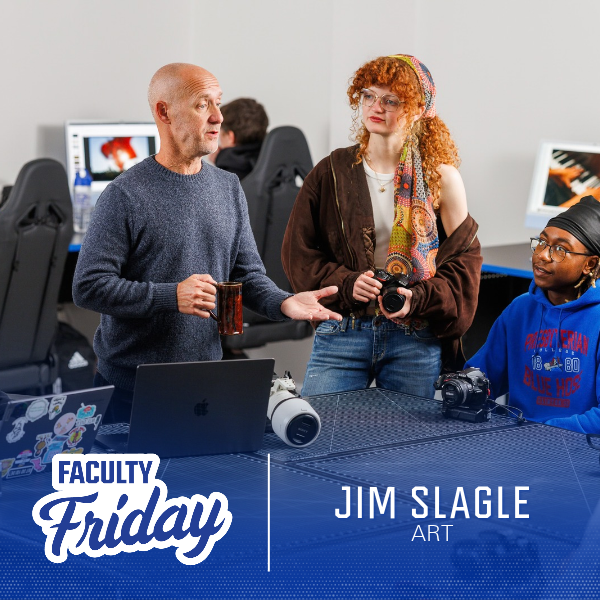
For Jim Slagle, associate professor of art at Presbyterian College, digital media design is not just a career; it is an everchanging field that has given him the opportunity to work professionally, teach students, and continue his own creative work.
Slagle is in his second year at PC after spending 17 years at Lander University, where he established their graphic design program in 2007. PC gave Slagle the opportunity to continue working in design and emphasizing a focus on expanding the art curriculum to include more coursework in graphic and interactive design.
From Industry to the Classroom
The path leading Slagle to teaching was not straight. After earning his undergraduate degree in visual communications and photography from Towson State University, Slagle spent more than a decade in the design industry before deciding to go back to school to pursue his Master of Fine Arts in Graphic Design at Florida Atlantic University in 2005.
While Slagle was working as a creative director for a marketing firm in Spartanburg, he started teaching graphic design as an adjunct professor at Converse College and really started to enjoy the classroom. This is when his career focused shifted.
His newfound passion for teaching led him to Lander University in Greenwood, where he pursued a full-time teaching position that kept him there until 2025. During his time at Lander, Slagle introduced graphic design as a concentration within the visual art degree and eventually grew the program and developed the degree into a professional Bachelor of Design (BDes). He also served as the chair of the art department for six years.
The Real and Changing World of Design
Today, Slagle’s areas of interest remain in graphic and interactive design. In a world where technology is so prominent but also always changing, there is constantly something for designers to learn.
“If you neglect the newest technologies in design, you’ll quickly fall behind,” Slagle said.
The need to keep up with the next big thing translates into the classroom. In addition to giving typical lectures and leading discussions, Slagle strives to make his design studio classes feel like a real-world, creative workplace, where he serves as the creative director to a team of designers as opposed to the teacher/student roles in a typical classroom.
Learning what graphic design is and how to use industry-standard software is an important part of Slagle’s classes, but it isn’t the only priority. He also wants students to develop professional habits and soft skills that will serve them long after graduation.
“Of course, I want my students to understand design and know how to use the software,” Slagle said. “But I also want them to develop skills like problem-solving, time management, communications, punctuality, and going beyond the minimum expectation. These are the kinds of things that can set you apart professionally and earn you the benefit of the doubt when you need it.”
Of course, I want my students to understand design and know how to use the software. But I also want them to develop skills like problem-solving, time management, communications, punctuality, and going beyond the minimum expectation. These are the kinds of things that can set you apart professionally and earn you the benefit of the doubt when you need it.”
Jim Slagle, Associate Professor of Art
Helping Students Find Their Way
One of the most rewarding parts of teaching, Slagle said, is following his students’ post-graduation and getting to see what they do.
He frequently shares stories of former students with his current students, including a former student who now works for Nike’s Air Jordan apparel line. Slagle works to maintain relationships with his past students and enjoys hearing how his classroom lessons have helped them in their future careers.
“I love hearing from old students,” Slagle said. “Hearing their success stories and watching them develop in the real world is very rewarding to me.”
Beyond the Classroom
When he is not teaching, Slagle spends time on Lake Greenwood, where he lives with his family. His career in graphic design and photography is ongoing, including sports and nature photography.
In addition to many clients who he designs and photographs for; he is currently working on a passion project, a calendar featuring the birds of Greenwood.
Future of Design at PC
Slagle hopes to continue developing opportunities for students interested in design. PC now offers an art major with digital media design concentration, and digital media design minor. Slagle hopes that this gives students the opportunity to incorporate graphic and interactive design into their education.
Slagle finds the minor particularly exciting because it allows for people of all fields of study to explore design without it having to be their main area.
“I think there are a lot of students here that have explored graphic design a little bit and found it interesting, but don’t necessarily want to major in it,” Slagle said. “Adding a digital media design minor to many degrees can be a great way to make students more versatile and marketable as potential hires.”
Slagle has a vision for digital design at PC. He hopes that students will explore areas such as graphic design, interactive design, and digital media while developing skills that can be applied beyond the classroom.