
Information booth renovated into new Peace Pavilion.
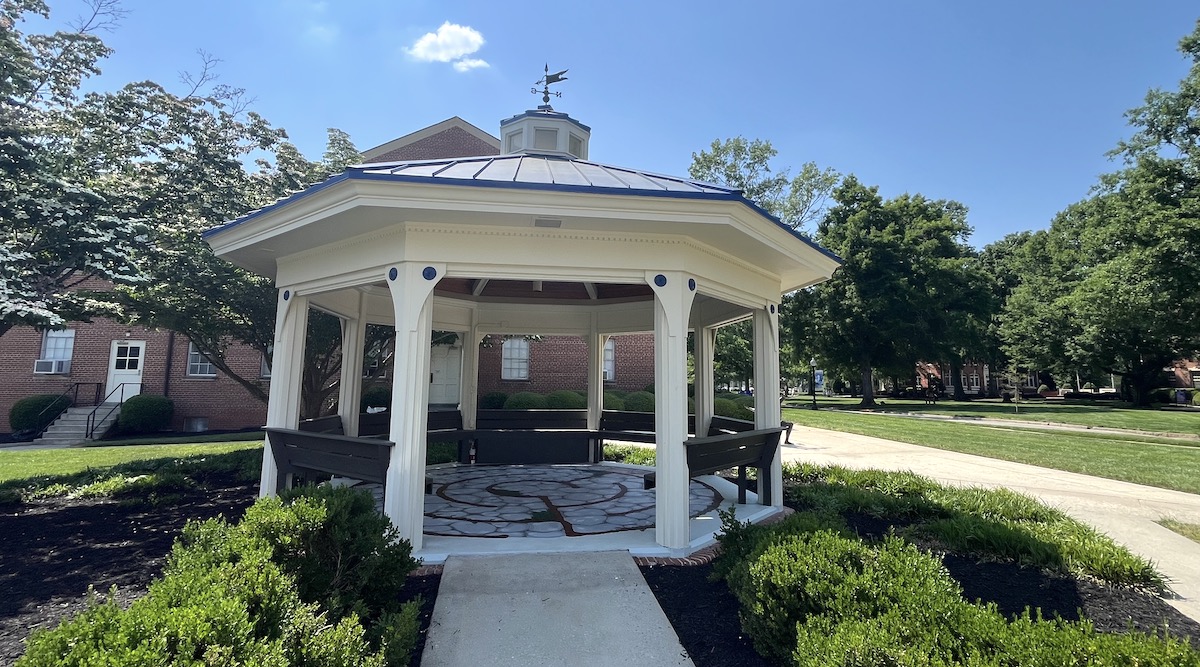
For generations of Presbyterian College students, the area near Douglas House has served many purposes.
It was once affectionately called “Jock Rock.” Before that, it was the site of the college’s first outdoor chapel and later as the space where an information booth resided.
Now, thanks to a collaboration involving students, faculty, staff, and the Office of Spiritual Life, the historic space has begun a new chapter.
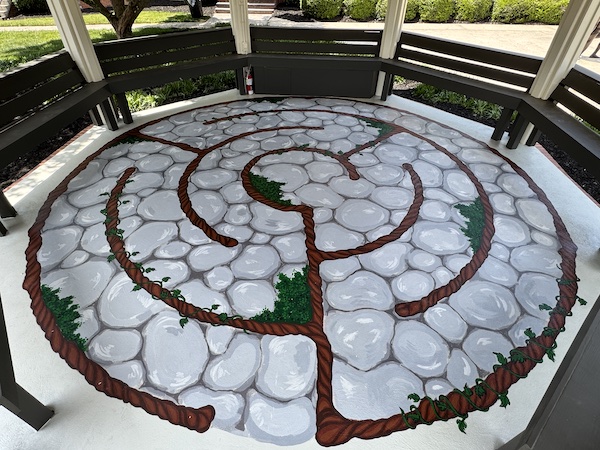
This spring, Presbyterian College officially unveiled the Peace Pavilion, a renovated open-air gathering space centered around a student-designed prayer labyrinth intended to provide a place for reflection, prayer, conversation, and community in the heart of campus.
For the Rev. Dr. Buz Wilcoxon ’05, Lassiter Chaplain and Dean of Spiritual Life, the project represents far more than a physical renovation.
“This really was an interdepartmental accomplishment,” Wilcoxon said. “It was great to see everyone come together in a unified way while each bringing their own distinct perspectives.”
Reimagining a Campus Landmark
The idea for the pavilion emerged from two separate conversations that ultimately converged into a single vision.
For several years, members of the Office of Spiritual Life had hoped to establish a prayer labyrinth somewhere on campus but had struggled to identify the right location. At the same time, the facilities department was considering ways to repurpose the former information booth, which had largely fallen out of use and was being utilized for storage.
When Wilcoxon learned of the facilities team’s interest in transforming the structure into an open-air pavilion, he saw an opportunity.
He shared an example of a pavilion and labyrinth at Montreat Conference Center with executive director of facilities Scott Respass, who embraced the concept and began working through the details. Cabinet-level approval followed, and planning began in earnest during the summer of 2025.
As the project developed, Wilcoxon discovered the deeper history of the site.
What many current students knew only as the abandoned information booth had once served as a gathering place for worship and celebration. That history made the transformation feel especially fitting.
“This historic spot is ready to welcome those who need to find a place of peace and prayerful reflection in the midst of our busy world and active campus,” Wilcoxon said.
A Classroom Project Becomes a Campus Legacy
Rather than simply installing an existing labyrinth design, college leaders decided to make the project an educational experience.
That decision led the project into the classroom of associate professor of art Jim Slagle.
When Slagle first saw the proposed concept, he immediately recognized an opportunity to create something unique while giving students real-world design experience. Drawing on years of professional experience as a creative director and graphic designer, he transformed the project into what he calls a “legacy project” — one that would enhance the campus experience for years to come.
“This was my first semester at PC,” Slagle said. “I was excited for the opportunity to engage students in a project that could have a lasting impact on campus.”
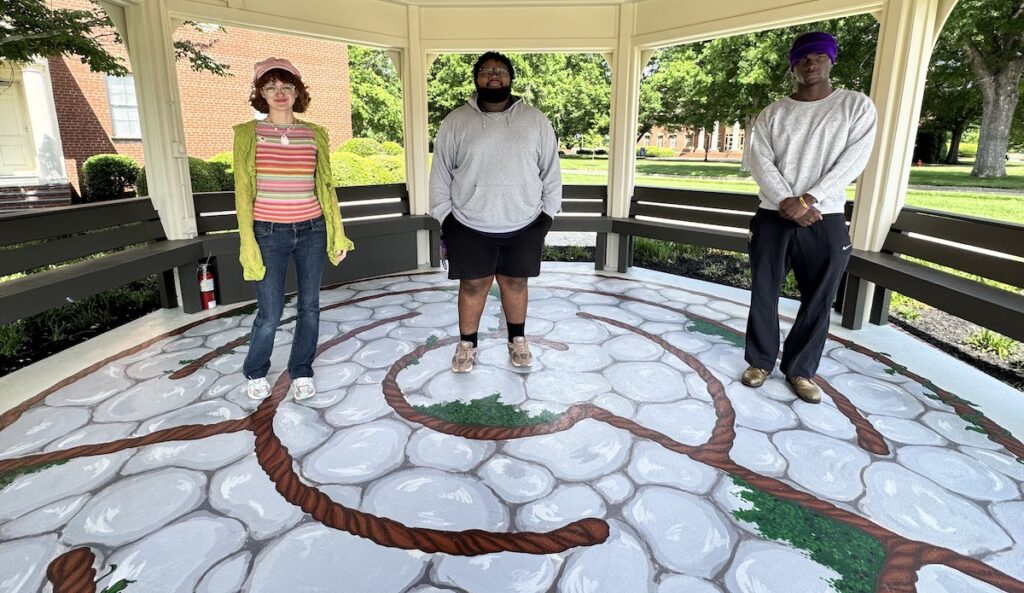
Students Peyton Phillips and MaLek Horlback took on the challenge through Slagle’s graphic design course. Rather than reproducing an existing labyrinth, they were tasked with creating an original design specifically for the pavilion and its purpose.
The project mirrored the workflow of a professional creative agency.
Students met with clients, conducted research, visited an existing prayer labyrinth in Greenwood, generated more than 100 preliminary sketches, and presented multiple concepts before refining a final design.
“The students acted as designers while I served in the role of creative director,” Slagle said. “They experienced every stage of a professional design process.”
The result was a labyrinth unlike any other.
Whether it is right before exams, on a Sunday morning, or in the middle of an everyday walk, a moment spent breathing, reflecting on life, enjoying nature, or talking to God, is a moment well spent.”
Lauren Smoak, Art Major
Art With Purpose
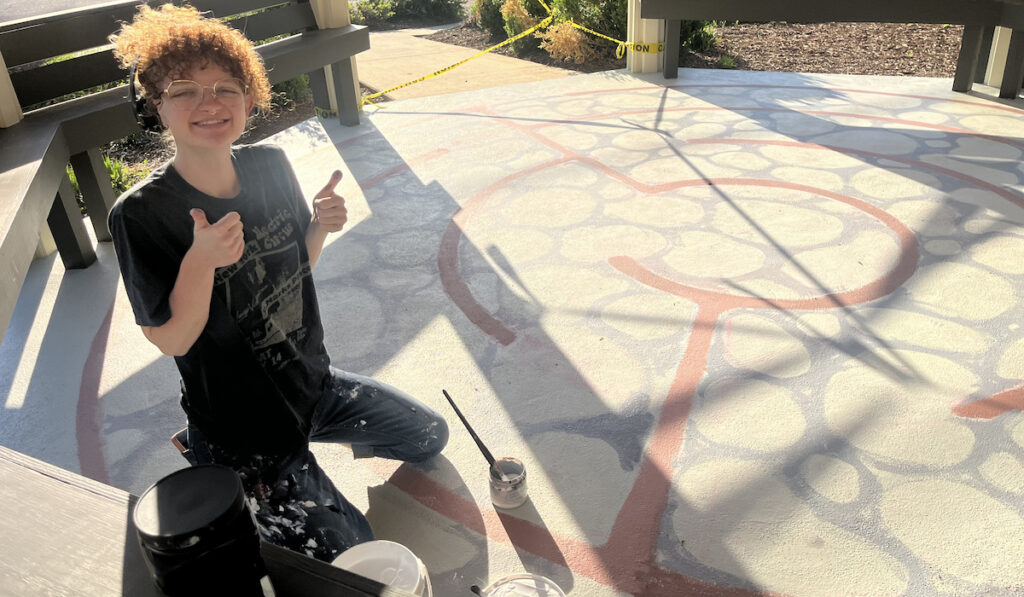
Once the design was finalized, bringing it to life fell to Lauren Smoak ’27, an art major who spent approximately 15 hours hand-painting the labyrinth onto the pavilion floor.
Smoak remembers arriving at Presbyterian College in 2023 and knowing the structure only as the “abandoned information booth.”
When she learned plans were underway to renovate the space, she eagerly followed the project’s progress and eventually became one of its principal creators.
Working alongside Slagle and professor of art Ralph Paquin, Smoak helped transform the students’ concept into a large-scale mural that now serves as the centerpiece of the pavilion.
The finished labyrinth incorporates layers of symbolism rooted in Christian tradition.
Its three concentric circuits represent the Holy Trinity. Seven turns throughout the path reflect the biblical significance of seven as a symbol of divine perfection and completeness. Additional elements represent steadfastness, growth, perseverance, renewal, and the cross.
But for Smoak, the most important aspect of the labyrinth is not its symbolism alone. It is its purpose.
Unlike a maze, which requires choices and problem-solving, a labyrinth follows a single path.
“It serves as a place of peaceful meditation, where one can re-center themselves during the chaos of everyday life,” Smoak said.
A Place for Peace
The completed pavilion was designed with multiple forms of engagement in mind.
The labyrinth encourages prayer and reflection. Wraparound benches invite conversation and community. The open-air structure creates a connection to nature and the surrounding campus landscape.
Already, Respass has noticed students and faculty members using the space for relaxation and informal gatherings. He hopes the pavilion will continue to evolve as a place where students can connect with one another, participate in worship opportunities, and discover the deeper meaning behind the labyrinth.
“I think the project turned out wonderfully,” Respass said. “It is centered on the campus, looks clean and inviting.”
Wilcoxon agrees.
Among the many aspects of the project he appreciates, the collaboration stands out most.
“The labyrinth at the Peace Pavilion is truly one of a kind,” he said.
For Smoak, however, the true success of the project will be measured not by the structure itself but by the people who use it.
Her hope is simple: that students, faculty, staff, and visitors will pause for a moment amid the demands of daily life and walk the path.
“Whether it is right before exams, on a Sunday morning, or in the middle of an everyday walk,” she said, “a moment spent breathing, reflecting on life, enjoying nature, or talking to God, is a moment well spent.”