
Two Schools. Two Degrees. One Nursing Career.
If you’re called to a career in nursing, Presbyterian College offers a unique pathway that combines the personalized attention of a nationally respected liberal arts college with one of the Southeast’s leading nursing programs.
Through the PC–Mercer Nursing Dual-Degree Program, you’ll complete three years at Presbyterian College earning a Bachelor of Science in Biology with a Concentration in Nursing before transferring to Mercer University’s Georgia Baptist College of Nursing for two years to complete your Bachelor of Science in Nursing (BSN).
Graduate with two bachelor’s degrees in just five years—a biology degree from Presbyterian College and a BSN from Mercer University—and enter one of the nation’s most in-demand professions prepared to provide compassionate, evidence-based patient care. The program was created to address growing healthcare workforce needs while combining the strengths of both institutions.
The Power of Your Degree
- Expand your perspective.
Prepare for a nursing career through a curriculum grounded in science and patient care. - Broaden your knowledge.
Pair your science coursework with the humanities, social sciences, and communication. - Solidify your skill set.
Build the scientific, laboratory, analytical, and problem-solving skills for success in nursing. - Become a critical thinker.
Evaluate evidence, solve complex health challenges, and make informed clinical decisions.
5 Years
Complete two bachelor’s degrees
2 Degrees
B.S. Biology (PC)
B.S.N. (Mercer)
12:1 Student-To-Faculty Ratio
In discussion-based classroom settings
A Partnership with Purpose WHY MERCER?
Mercer University’s Georgia Baptist College of Nursing is one of the Southeast’s most respected nursing schools.
The partnership between Presbyterian College and Mercer University was built around a shared commitment to academic excellence, servant leadership, and preparing compassionate healthcare professionals.
Presbyterian College provides students with the rigorous scientific preparation that allows them to transition seamlessly into Mercer’s nationally recognized BSN curriculum.

What You’ll study
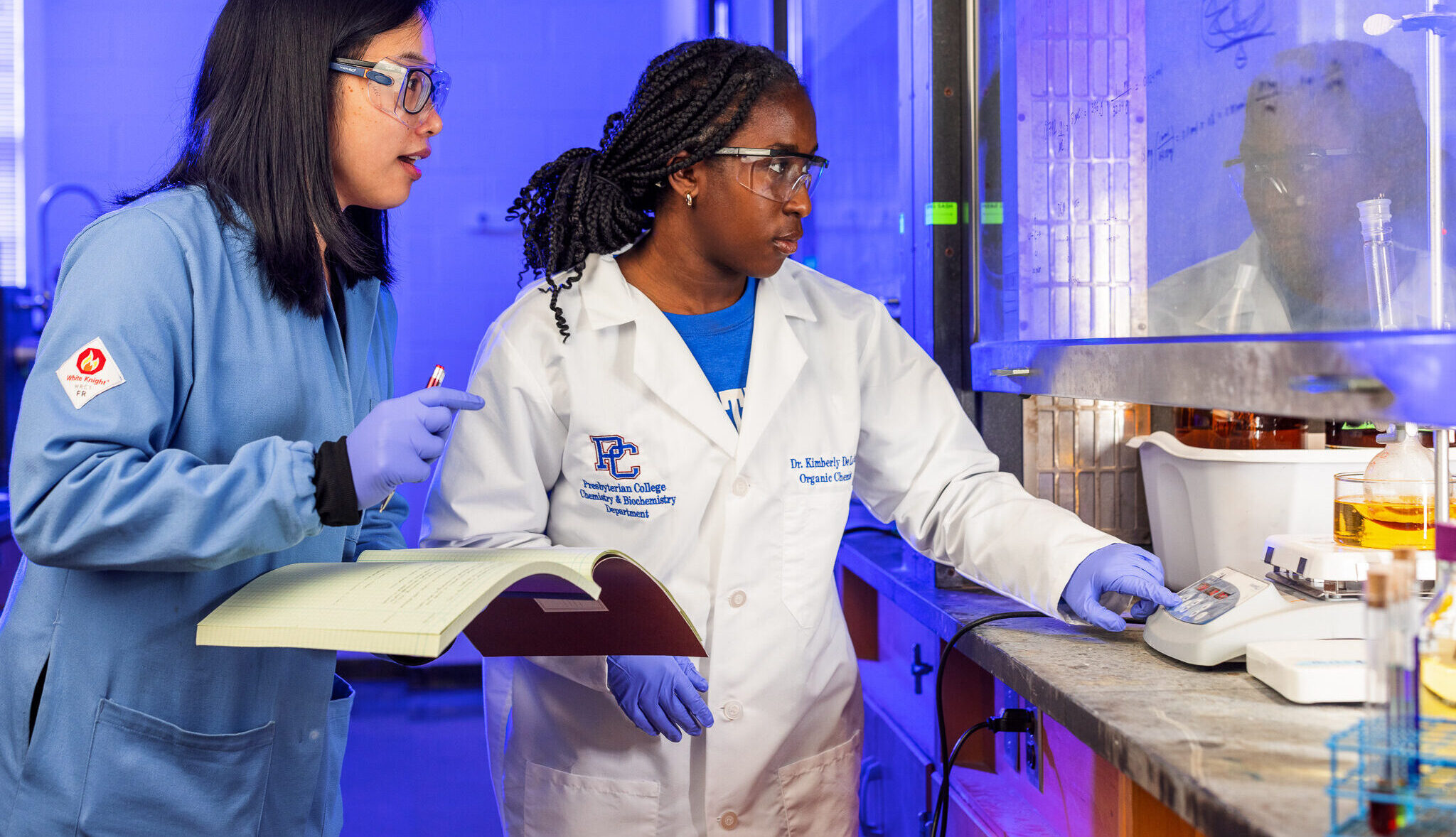
Your first three years focus on the biological sciences while satisfying Mercer University’s nursing prerequisites.
Students complete Presbyterian College’s liberal arts core while developing the scientific knowledge, laboratory experience, communication skills, and critical thinking expected of future healthcare professionals.
After transferring to Mercer University, students complete upper-level nursing coursework, clinical experiences, leadership training, pharmacology, nursing research, and practicum experiences leading to the Bachelor of Science in Nursing.
Coursework includes:
- Biological Concepts
- Organismal Biology
- Genetics
- Microbiology
- Human Anatomy & Physiology I & II
- General Chemistry
- Organic Chemistry
- General Physics
- Psychology
- Lifespan Development
- Statistics
- Human Nutrition
- Pathophysiology
Get Involved
At Presbyterian College, you can actively pursue your passion for nursing through programs and opportunities that take your discipline out of the classroom and into the real world—all while expanding your experience, perspective, and skillsets.
Careers in NURSING
Graduates complete Mercer University’s BSN program and become eligible to pursue licensure as Registered Nurses. Many graduates later pursue advanced practice degrees, including: Nurse Practitioner, Certified Registered Nurse Anesthetist, Nurse Educator, Doctor of Nursing Practice (DNP).
The demand for registered nurses continues to grow throughout South Carolina, Georgia, and across the nation.
Career Professions
Emergency Nursing
Critical Care
Pediatrics
Neonatal Nursing
Oncology
Labor & Delivery
Surgical Nursing
Cardiac Care
Community Health
Public Health
Intensive Care
Nurse Leadership
Acquired Skills
Scientific reasoning
Laboratory techniques
Data analysis
Statistical methods
Attention to detail
Written communication
Research literacy
Time management
Critical thinking
Problem-solving
Collaboration and teamwork
Verbal communication
Ethical reasoning
Adaptability
Foundational health science knowledge
Discipline for rigorous coursework
Quick Stats
$93,600
Average Median Salary
The median annual wage for registered nurses was $93,600 in May 2024, according to the U.S. Bureau of Labor Statistics— nearly double the median wage across all U.S. occupations.
5% Growth
Projected Employment Rate
Employment of registered nurses is projected to grow 5 percent from 2024 to 2034, faster than the average for all occupations, driven largely by the healthcare needs of a growing older population.
189,100 Openings
Annual Job Openings Nationwide
About 189,100 openings for registered nurses are projected each year, on average, over the decade— most arising from the need to replace nurses who retire, transfer, or leave the workforce.
Source(s): U.S. Bureau of Labor Statistics