Ceremony marks the beginning of the Class of 2030’s professional journey and celebrates pharmacy’s traditions of service, honor and patient care
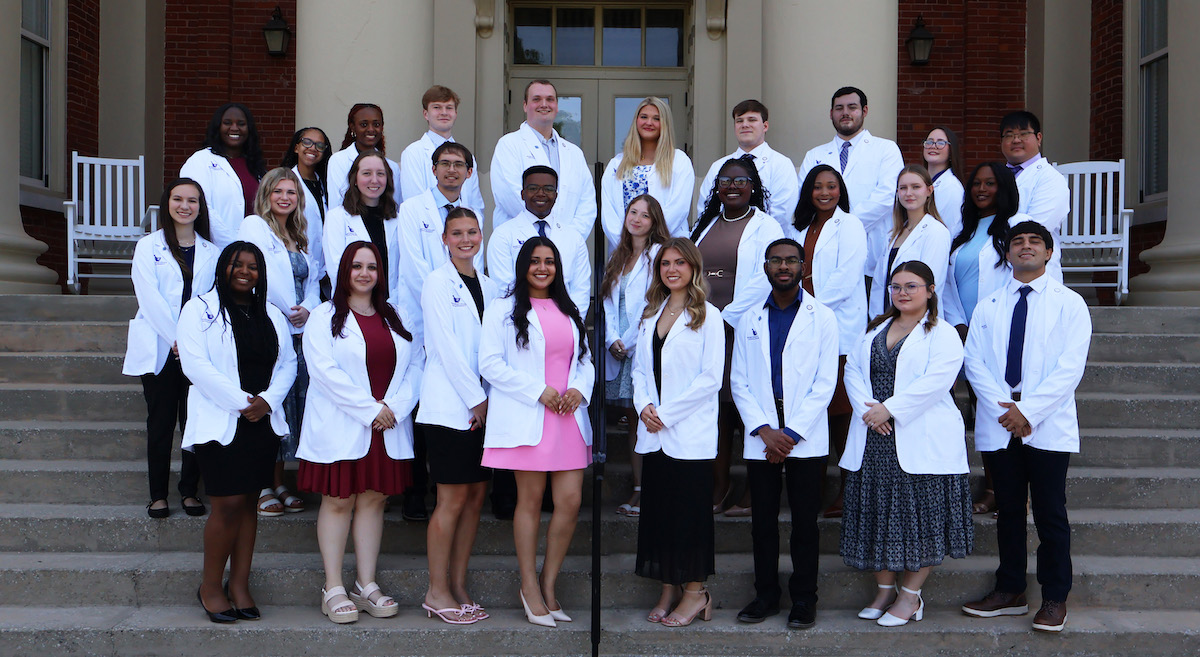
The white coats presented to the Presbyterian College School of Pharmacy’s Class of 2030 represent far more than a new piece of professional attire.
They represent responsibility, compassion, service and the beginning of a journey toward becoming pharmacists.
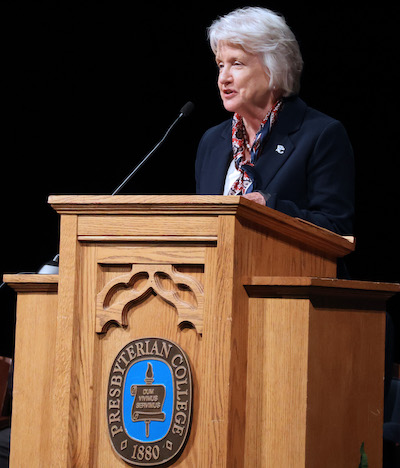
PC president Dr. Anita Gustafson welcomed the school’s newest pharmacy students during the 17th White Coat Ceremony, telling them that receiving their coats marked a significant first step in their professional development.
“This is an important milestone in your academic journey,” Gustafson said. “It took a lot of hard work and dedication to get to this point, and I have full confidence that you will be able to persist and be successful in your pursuit of your PharmD degree.”
Gustafson told the students they would gain the technical skills and scientific knowledge necessary to become pharmacists during their four years at PC. But she said their education would extend beyond science.
“At PC, you will learn more,” she said. “You will also learn, embrace, and demonstrate the vital skills of empathy and compassion that will set you apart from others.”
Gustafson also reminded the class of the college’s motto, Dum Vivimus Servimus — “While We Live, We Serve” — and the responsibility that accompanies the white coat.
A Record of Success
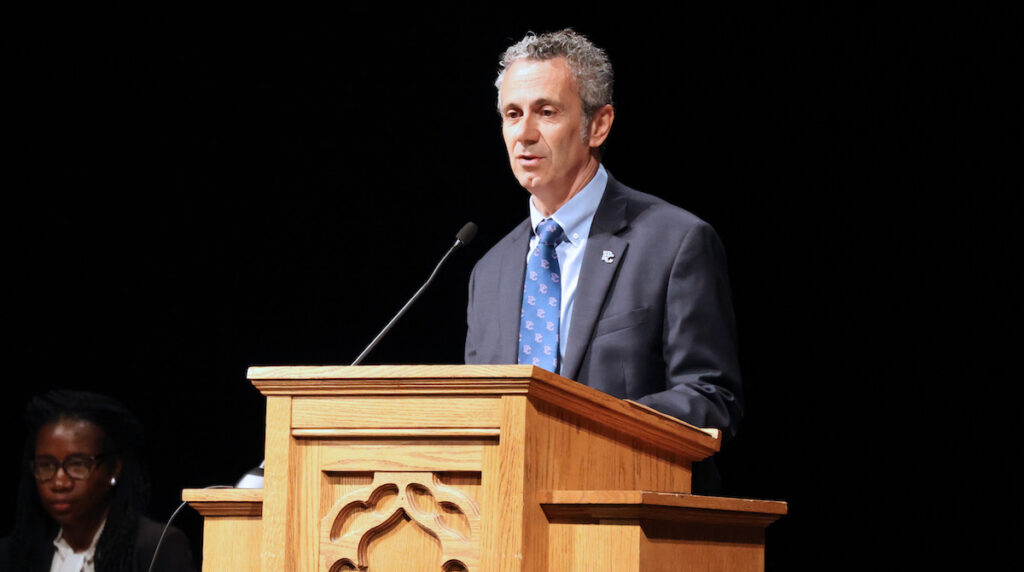
Dr. Giuseppe Gumina, dean of the School of Pharmacy, told members of the Class of 2030 that they were joining a program with a strong record of academic and professional success.
Gumina said PC has the best three-year average in South Carolina for first-time pass rates on both the North American Pharmacist Licensure Examination, or NAPLEX, and the Multistate Pharmacy Jurisprudence Examination, or MPJE, as well as a consistently strong postgraduate residency placement rate.
The Class of 2025 was one of only 10 pharmacy classes in the country to achieve a passing average higher than 90% on both examinations, Gumina said, while the Class of 2026 is on track for another strong performance.
“Impressive numbers aside, the competence and professional success of our graduates stand as the most important testimony to the quality of our program,” he said.
Gumina told the new students their coats symbolize “professionalism, care, trust, and responsibility” and challenged them to embrace PC’s culture of service throughout their education.

I can remember receiving my white coat and wearing it my entire drive home just because I did not want to take it off.”
Dr. Michael Shaw ’21, Pharmacist, Bon Secours St. Francis Downtown Hospital
More Than a White Coat
Dr. Michael Shaw ’21 knows exactly what receiving one of those coats feels like.
Shaw, PC School of Pharmacy’s 2025-26 Alumnus of the Year and a preceptor for the school, delivered the ceremony’s keynote address. He recalled sitting in the same position as the new students only a few years earlier, filled with excitement, anxiety and motivation.
He even remembered what happened after his own White Coat Ceremony.
“I can remember receiving my white coat and wearing it my entire drive home just because I did not want to take it off,” Shaw said.
Now lead antimicrobial stewardship pharmacist at Bon Secours St. Francis Downtown Hospital, Shaw returned to PC to tell the Class of 2030 what he believes their new coats should mean.
He organized his message around three ideas: the history of pharmacy, the values and integrity of the PC School of Pharmacy, and the individual student — along with the people who will support each student through the next four years.
Stepping Into a Historic Profession
Shaw first placed the students within a profession whose history stretches back thousands of years. From the medicines of ancient Egypt and the separation of physicians and herbalists in ancient Greece to the development of pharmacies in Baghdad and the founding of the American Pharmacists Association in 1852, Shaw described a profession that has continually evolved while retaining the trust of the people it serves.
“By earning your white coat today, you are stepping into a profession shared with those previously mentioned,” he said.
But Shaw said the students were also entering something more immediate — the culture of the PC School of Pharmacy.
A Place Invested in Students
He spoke candidly about his own arrival at the school in 2017, describing himself at the time as an objectively below-average student in both effort and performance. His previous academic experiences, he said, had often left him feeling like little more than “a warm body filling a seat.”
PC was different.
Within his first semester, Shaw said, he became comfortable talking with professors outside the classroom because they had taken the time to know him personally.
“Truly, I felt, and still believe, that they were just as invested in my success as I was,” he said.
That investment helped shape Shaw not only as a pharmacist but also as a person committed to service. He urged the Class of 2030 to embrace Dum Vivimus Servimus and the opportunities they will have to serve others during pharmacy school.
He also encouraged them to invest in relationships.
Shaw offered his own wedding as evidence of how important the relationships formed during pharmacy school can become. His officiant, three groomsmen, numerous guests — and his bride — were all people he met during his pharmacy training.
“I would wager that many of you out there today will leave this school in four years with some of your lifelong friends as well,” he said.
What Fills the White Coat
Finally, Shaw turned from what the coat represents to what fills it.
“You, as an individual,” he told the students, are the most important part.
He warned that long nights, hard work and unexpected challenges await them and urged students to rely on family, friends, classmates and their faith. He also encouraged them to protect their physical and mental well-being, reminding them that their own wellness will ultimately affect the care they provide their patients.
“Give the next four years everything you have,” Shaw said, “and I assure you that you will get back what you put in two-fold.”

A Commitment to Honor
The ceremony also underscored that becoming a pharmacist requires more than academic achievement.
Dr. Scott Kincaid, assistant dean for student affairs, reminded the students of the School of Pharmacy’s core values of service, honor, integrity and professionalism.
Members of the Class of 2030 publicly affirmed those principles by reciting and signing both Presbyterian College’s Honor Code and the pharmacy Pledge of Professionalism.
The tradition reflects PC’s longstanding emphasis on ethical behavior and personal integrity. Faculty and students have signed the college’s honor roll upon joining the PC community since 1915.
Kincaid told the students that honor is not only a core value of Presbyterian College but also fundamental to pharmacy, a profession that requires practitioners to uphold the highest standards of moral, ethical and legal conduct.
Following the pledges, each P1 student crossed the stage to receive a white coat before signing the Roll of Honor and Pledge of Professionalism.
‘Compassion and humility’
Gumina closed the ceremony by returning to the meaning of the garment the students had just received.
“Each time you wear your white coat, know that you are not only representing Presbyterian College, but also the many that have come before you,” he said.
He asked the Class of 2030 to remember its commitment to professionalism, honor and service throughout the four-year journey ahead.
“Wear this white coat with compassion and humility,” Gumina said. “Wear it with confidence and pride.”
Meet the Class of 2030
The Presbyterian College School of Pharmacy Class of 2030 includes:
- Martina Sherif Azer — Bob Jones University — Presby First+
- Prusher Thomas Bair — University of South Carolina
- Latyanna Idaejah Black — Clemson University — Presby First+
- Mackenzie Marie Blankenship — Midlands Technical College — Presby First+
- Phillip Rankin Byrd — Presbyterian College
- Jacob Harrison Cannon — Presbyterian College — Presby First+
- Jerry Cooper Caulder — Lander University
- Trinity Grace Edwards — University of South Carolina
- Jordan Rose Esslinger — University of South Carolina
- Juan Carlos Garcia, Jr. — Lander University — Presby First+
- Lauren Elizabeth Grooms — Clemson University
- Hannah Lee Hamilton — Presbyterian College — Presby First+
- Jomana Atef Hanna — Massachusetts College of Pharmacy and Health Science — Presby First+
- Abigail Doreen Johnson — University of South Carolina
- Katherine Taylor Keith — Lander University
- Raven Jamya Kelly-Bowens — Claflin University — Presby First+
- Sung Won Kim — Midlands Technical College — Presby First+
- Mandolin Elizabeth Lucier — Clemson University — Presby First+
- Amaiya Jade McDowell — Lander University — Presby First+
- Ryanna Shekia Moore — University of South Carolina
- Jordan Hunter Patterson — Clemson University
- Hannah Grace Sanders — Presbyterian College — Presby First+
- Kennedy Maerine Scott — University of South Carolina — Presby First+
- Eric Michael Slacum — Presbyterian College — Presby First+
- Taylor Brooke Tate — University of South Carolina — Presby First+
- Riley Thomas Tumblin — Presbyterian College — Presby First+
- McKenzie Rain Wessel — Presbyterian College — Presby First+
- Kaitlyn Savannah Williams — Lander University — Presby First+