Presbyterian College’s emphasis on student research took the spotlight during the annual Summer Research Symposium last month.
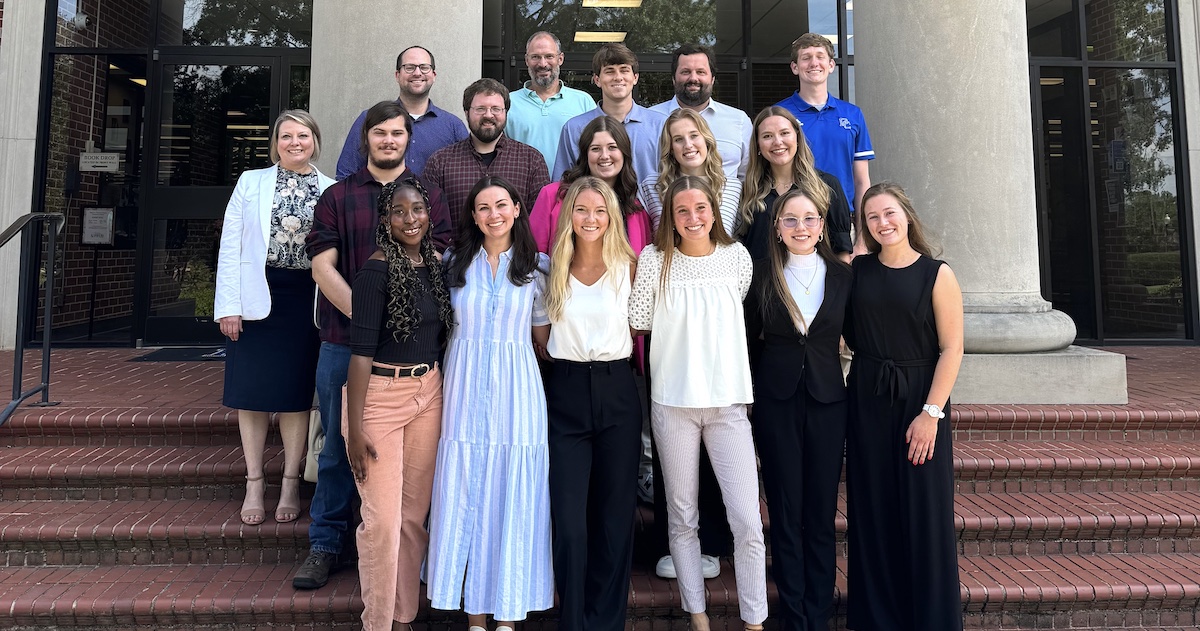
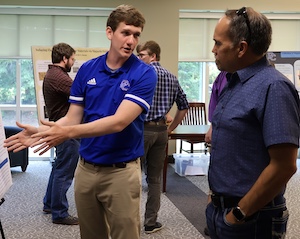
A dozen PC students presented their findings throughout the daylong event, including oral presentations in the Harrington-Peachtree amphitheater and poster presentations in James H. Thomason Library.
The event was organized by Dr. Drew Brandel ’13, director of the PC Summer Fellows Program and assistant professor of psychology, and highlighted research done by students between semesters this year.
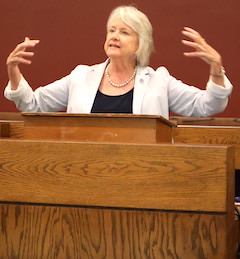
PC president Dr. Anita Gustafson, who has made student research a signature focus of her presidency, delivered the symposium’s keynote address – “Research: Cultivating Pathways for Leadership.” In her speech, Gustafson argued that research develops leadership skills that are much needed in today’s world.
“To me, the common denominator in the research that you all are doing is curiosity,” she said. “You start by asking questions.”
Finding evidence, gathering data, or looking deeply into a subject of interest often yields more questions and even failed experiments or busted theories can lead to new discoveries.
“It may shape and reshape the conclusions or the ideas you had at the outset of your journey, Gustafson said. “But really, the issue here is that in order for you to research and reach a conclusion based on evidence, you have to continue to be curious. You cannot predetermine or judge where you’ll end up before you even start your research journey.”
Gustafson used an episode of the popular series, “Ted Lasso,” to illustrate what it means to lack curiosity. In that episode, Richmond’s former owner, Rupert, challenges Coach Lasso to a game of darts, wrongly assuming that Ted is able to match his expertise. As Ted wins the match, he quotes Walt Whitman – “Be curious, not judgmental” – and informs Rupert that had he been curious, he would have asked questions and learned that his opponent played darts every Sunday with his father until the day he died.
“This idea of being curious and not judgmental is what you are doing, and what I do in my work,” Gustafson said. “The curiosity that you have embraced in your research, and the path of research that it has taken you to reach some conclusions, is the kind of pathway that will prepare you for being a good leader. For being curious, asking questions, and reaching a decision.”
As an historian, Gustafson said her research explores human experiences of the past to determine how and why people made their decisions in a particular historical context. Inspired by her Swedish immigrant grandparents who settled in Chicago, for example, Gustafson’s curiosity fostered a love of Swedish history and culture that led her to study Swedish, visit Sweden, and culminated in her doctoral dissertation and book, Swedish Chicago: The Shaping of an Immigrant Community, 1880-1920.
Doing her own research, asking her own questions, and challenging conventional viewpoints led Gustafson to gather new evidence and reach new conclusions about Swedish immigration patterns in the Midwest. She said research also impacts her life as a leader in higher education.
“Ideally, when making decisions, I ask questions,” Gustafson said. “I listen to ideas and opinions and options that others may offer. I do my research as much as time allows, because time is a factor in my busy world.But in short, I’m curious. I try to make a decision based upon what I’ve learned.”
Leaders who believe they already have all the answers often make poor decisions, she added.
“I know I don’t always get it right, but I do believe that by asking questions and learning from others, it fosters a sense of empathy,” Gustafson said. “Not that you always follow their advice, but that you have taken the time to listen and consider their ideas, I think is an important part of leadership.”
By encouraging students to be curious, do research, and discover, Gustafson said PC cultivates pathways for leadership and service.
“The curiosity that you show by engaging in careful research helps prepare you to become an empathetic servant leader,” she said.
To underscore PC’s commitment to service and research, Gustafson shared two new initiatives – Engaged, Partnerships, Interdisciplinary, Connected (EPIC) Service, and the new Center for Inquiry, Research, and Scholarship (CIRAS). EPIC Service is an interdisciplinary program where service will be embedded in a wide variety of courses students can take to earn a micro-credential. CIRAS will bring a new focus on engaged student research and scholarship opportunities.
“Studies show that engaged learning, particularly research that students and faculty conduct collaboratively, makes a significant impact on students’ academic journeys,” Gustafson said. “It allows you to explore new ideas, to work collaboratively, and to think analytically, critically, and creatively as you pull together conclusions.
“Engaged learning embraces curiosity, a key ingredient of a liberal arts education. And I firmly believe that the research you are doing here today, now, will cultivate you for a pathway toward being the leaders of today and tomorrow.”
Students who presented at the Summer Research Symposium include:
MacKenzie Partsch
“Utilization of Magnetically Induced Jamming in a Universal Gripper”
Funded by: SC IdDeA Networks of Biomedical Research Excellence (SC INBRE)
Advisor: Eli T. Owens, Ph.D.
Amanda Bailey
“Targeted Delivery of Carbon Monoxide: Enhancing Therapeutic Potential Against ROS-Mediated Diseases”
Funded by: Organic Syntheses Principally Undergraduate Institutions (OS PUI)
Advisor: Kimberly C. De La Cruz, Ph.D.
Rivers Krask
“Understanding the Coordination Chemistry of Tellurium Supported by Redox-Active Ligands”
Funded by: S.C. Independent Colleges and Univerversities (SCICU)
Advisor: Caleb J. Tatebe, Ph.D.
Margaret Leonard and Abbi Weatherford
“The Synergistic Effects of BET Bromodomain Inhibitor JQ1 and Stress Induction in Triple Negative Breast Cancer Cells”
Funded by: SC INBRE
Advisor: Austin Y. Shull, Ph.D.
Reece Bradberry
“The Identification of Bacteria for Mutagenesis Capability”
Funded by: SC INBRE
Advisor: Stuart G. Gordon, Ph.D.
Margaret Leonard
“Specific Histone Arginine Methylation Sites Identified by Histone Proteomic Profiling are Depleted Through Dual p53 and PTEN Deletion in Metastasis-Transformed MCF10A Breast Cells”
Funded by: SC INBRE
Advisor: Austin Y. Shull, Ph.D.
Bethany McManus
“Predicting Orthologous Groups of Proteins/Domains with Graph-Based Clustering Algorithm”
Funded by: SC INBRE
Advisor: Margot Petukh, Ph.D.
Kayla Ponchamni
“α-Ketothioesters: Novel Approach for Carbon Monoxide Release for Therapeutic Applications”
Funded by: SC INBRE
Advisor: Kimberly C. De La Cruz, Ph.D.
Caroline Rairigh
“Combating Loneliness and Fostering Connection Among Today’s College Students”
Funded by: PC Summer Fellows
Advisor: Drew S. Brandel, Ph.D.
Abigail Weatherford
“Open Chromatin Regions Identified by ATACseq Correspond with Overexpression of Metastatic Drivers in Dual p53/PTEN-Deleted Metastasis- Transformed MCF10A Breast Cells”
Funded by: SC INBRE
Advisor: Austin Y. Shull, Ph.D.
Raiden Bailey
“Inducing Fluidization in Granular Materials via Magnetic Fields”
Funded by: PC Summer Fellows
Advisor: Eli T. Owens, Ph.D.
Warner Bush
“Liberalism and Conservatism: A Study of Ideological Change in 21st-Century American Politics”
Funded by: PC Summer Fellows
Advisor: Erin S. McAdams, Ph.D.
Lasha Facey
“Displacement-Based and De Novo Construction Approaches for Fluorescent Carbon Monoxide
Detection and Monitoring”
Funded by: SC INBRE
Advisor: Kimberly C. De La Cruz, Ph.D.
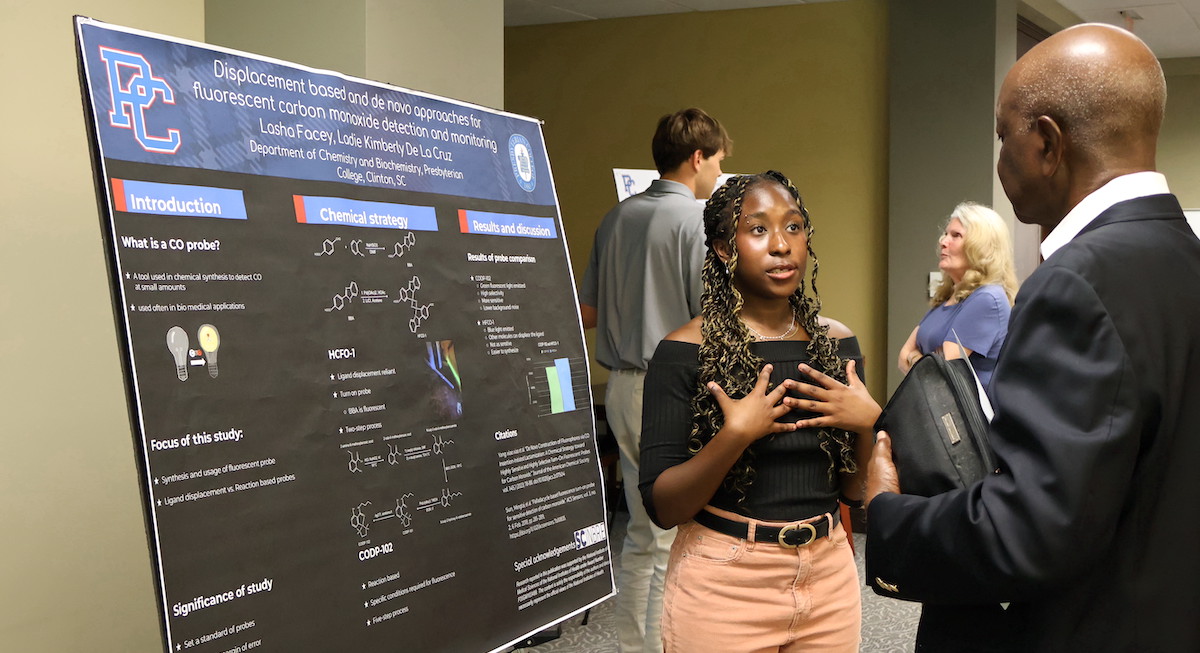
Presbyterian College student Lasha Facey presents her findings during a poster session at the annual Summer Research Symposium.